
Most candles do not fail because the wax was cheap. They fail in the first two hours, on the first burn, because the wick was too long, the room had a draft, or somebody blew it out after forty minutes and called it done. The scented candle first burn is the whole product in miniature. Get the melt pool to the glass and you have a jar that burns evenly all the way down. Miss it and you have a tunnel, a mushroomed wick, and a candle that smells like nothing by week two.
I spent nine years in the pouring room of a contract candle factory outside Cincinnati, where the same soy-paraffin blend went into a dozen different jars and the brand name on the lid was somebody else's problem. Then I ran a 300-square-foot candle shop on the edge of Over-the-Rhine for four years, pouring my own soy in the back and stocking other makers' jars up front. Customers asked the same question every day, which one should I buy, and I got tired of answering it with a guess. So I started burning every candle I stocked at home, in a closed 12x12 room, with a stopwatch, a notepad, and a ruler for flame height. The shop lasted four years. The burn journal outlived it.
What follows is the routine from that journal, plus two jars that make it hard to get wrong.
Why you should trust me
I learned wicking from a laminated chart on a factory wall and a foreman named Ray who could identify a wick by running it between his fingers before he let anyone near a pouring pot. Nine years of that teaches you that a candle is a wax, a wick, and a fragrance that have to agree with each other, and that the label is the last thing you read, not the first.
Since 2018 I have kept a burn journal: candle, wax blend, wick type, jar diameter, flame height at hour one and hour three, soot, mushrooming, and hot throw measured from across a closed 12x12 room. Nothing gets recommended on this site without fifty or more logged burn hours behind it, across multiple three and four hour sessions. I still trim my wicks with kitchen scissors, and I still tell everyone else to buy a ten dollar trimmer, which is a contradiction I have made peace with.
How I picked and how I tested
Both jars in this guide sit in the eight to nine ounce range, which is the format I point first-timers to. It is small enough that a single wick can bring the melt pool to the glass inside a normal session, and large enough to be worth the burn.
Every candle that gets written up here goes through the same protocol in the same closed 12x12 room:
- Wick trimmed to a quarter inch before the first light.
- Three to four hour sessions, never longer.
- Melt pool measured against the glass with a ruler at the one, two, and three hour marks.
- Flame height logged at hour one and hour three.
- Soot and mushrooming checked at hour four.
- Hot throw judged from across the room, not with a nose hovering over the jar.
The pass line is simple. The melt pool should reach the glass on every side within two to three hours of the first burn. If it is still an inch short at hour three, the wick is undersized for that jar and that wax, and no amount of patience will fix it. Flame height should hold between three quarters of an inch and an inch and a half. Taller than that and you are making soot, shorter than that and the wick is drowning, which means a weak throw no matter how good the fragrance oil is.
I do not print a throw number I did not measure in that room, and I do not recommend a jar I have not taken past fifty burn hours.
The two jars I would start with
You can run this routine on any candle already in your house. But if you are buying new, start with a single wick jar in the eight to nine ounce range, because that is the format where the first burn is easiest to read and easiest to rescue. Here are the two I would hand a first-timer.
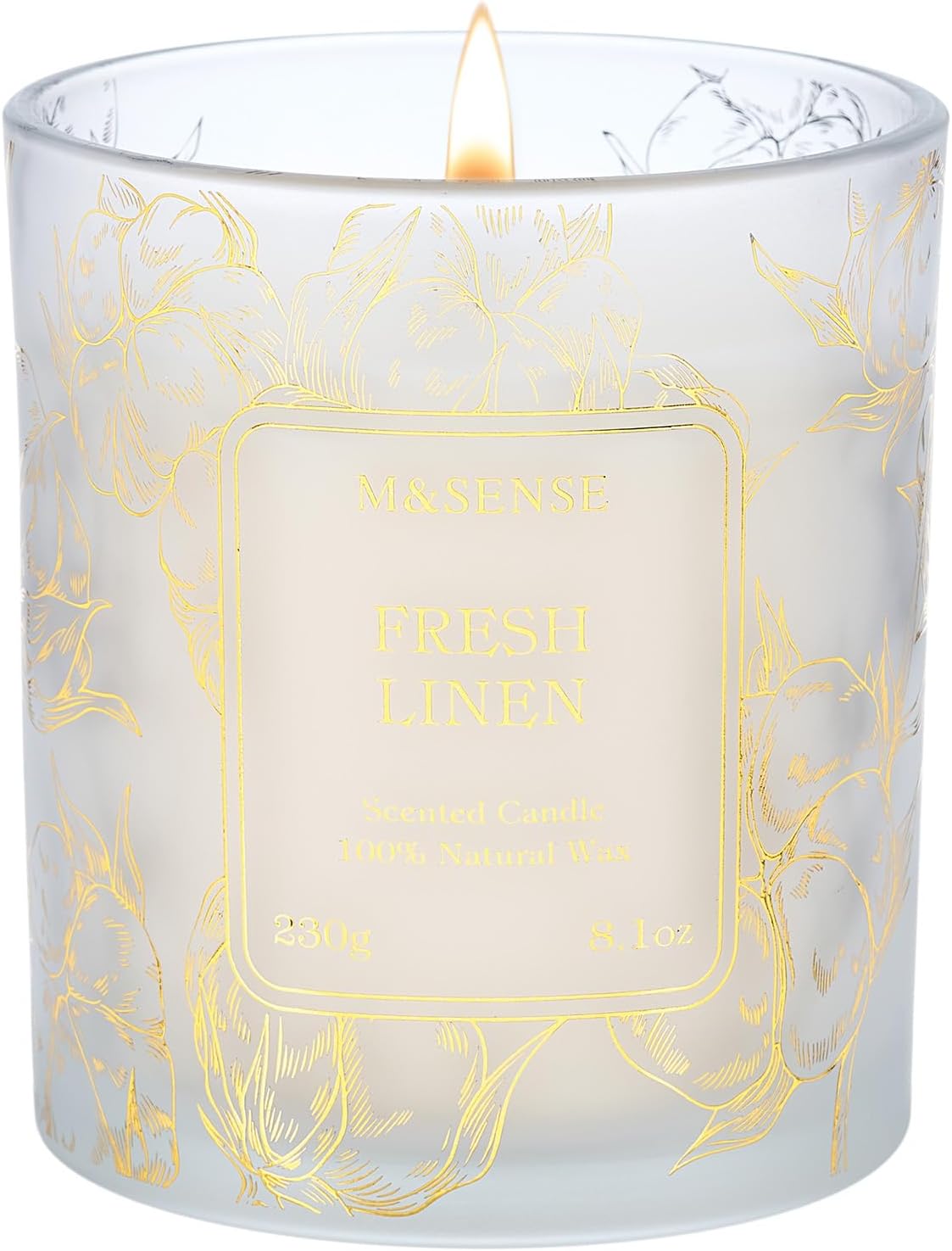
The linen pick: M&SENSE Fresh Linen Soy Candle, 8.1oz Gilded Glass, Home Refresh Gift
 Visit on Amazon →
This is a soy candle in an 8.1 ounce gilded glass jar, and the format is exactly why it leads this guide. Soy sets up with a visible line between the melted wax and the solid wax, so you can watch the melt pool walk toward the glass instead of guessing where the edge is. The gilded glass helps too. The shine gives you a clean read on the wax edge and on any soot line, which is the thing you are checking at hour three.
Fresh linen is a clean, laundry-adjacent scent rather than a bakery one, which makes it the safer of the two for a bathroom, a hallway, or a gift where you do not know the person's taste. It is the kind of candle that makes a room smell finished rather than perfumed.
Flaws but not dealbreakers: One wick in an 8.1 ounce jar is a small-room tool. Do not buy it expecting it to carry an open floor plan. And linen scents read sharp to some noses, so if you can smell it cold before you commit, do that first.
Anyone buying a first candle for a bedroom or a bathroom, or a housewarming gift that has to be safe, should start here.
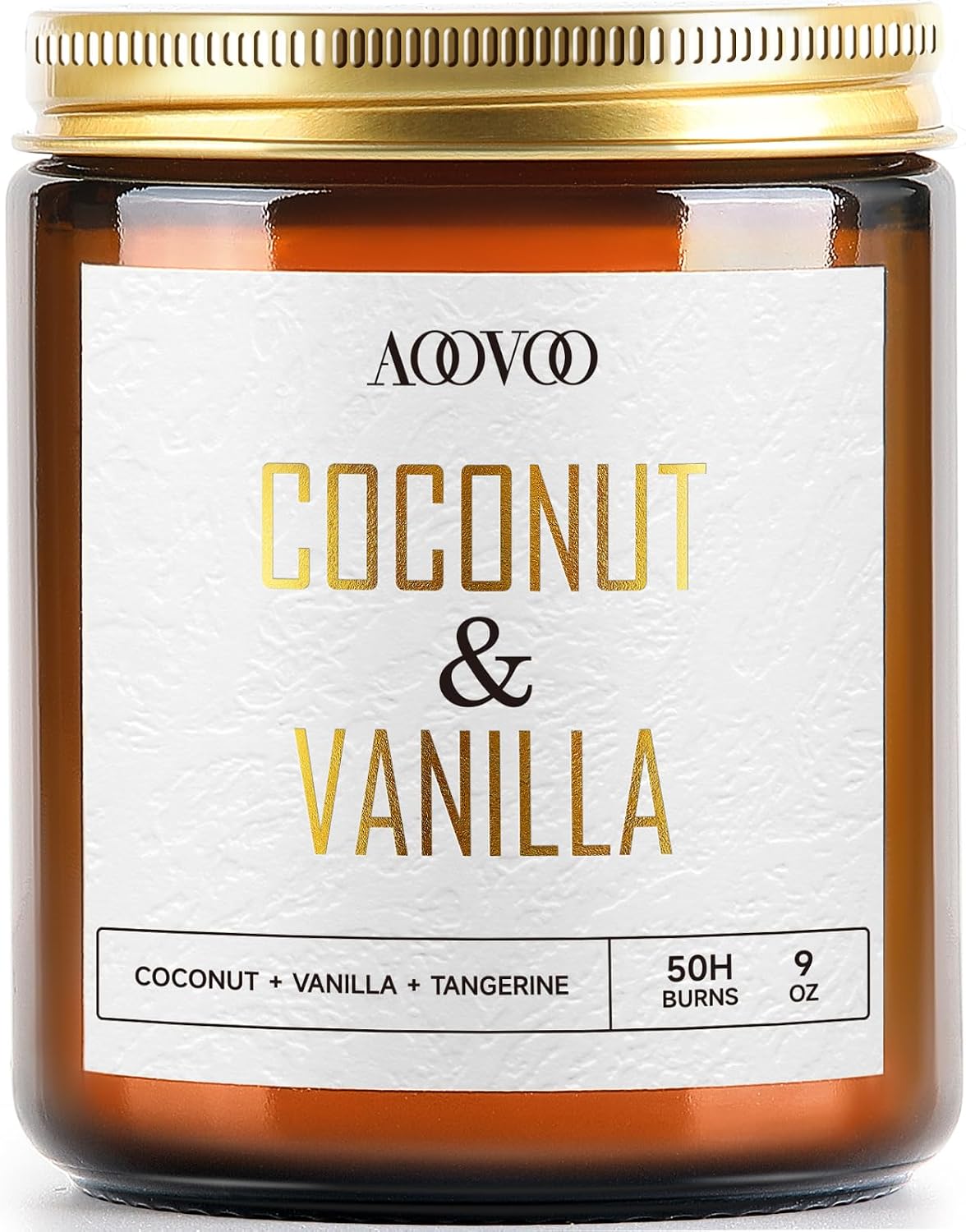
The vanilla pick: AOOVOO Coconut Vanilla Candles - 9 oz Scented Candles
 Visit on Amazon →
Nine ounces, coconut and vanilla, and the warmer of the two. Vanilla is a base note, which means it is the scent that tends to hang in a room after the flame is out, so this is the jar I would put in a bedroom or a living room for evening burns. The coconut keeps the vanilla from going full dessert, so it lands closer to a warm lotion than a cake.
Nine ounces is the upper end of what I would call first-burn-friendly. It is still small enough that one wick can bring the melt pool to the glass inside a normal session, which is the whole test, but you have less margin than you do with a smaller jar.
Flaws but not dealbreakers: Sweet scents are polarizing, and coconut vanilla is sweet. Burn it in a small closed room for four hours and you will know it is there. Trim the wick on this one every single burn, because a heavy sweet fragrance load plus a long wick is how you get a soot streak down the glass.
Anyone who wants a jar for a bedroom, a bath, or a long fall evening should look here.
The actual first-burn routine
Now the part you came for. This works on any jar candle at any price, and it is the same eight steps I run.
Step one: Trim the wick to a quarter inch. Not an eighth, not a half. A quarter inch. Every burn, not every other burn. Kitchen scissors work fine, and a trimmer works better. If the tip has a carbon ball on it, that is mushrooming, and it will kill your flame height and dim your throw until you cut it off.
Step two: Pick the spot, not the mood. Drafts are the enemy. Ceiling fans, HVAC vents, open windows, and doorways all push the flame around, and a dancing flame is a sooting flame. Level, heat-safe surface, nothing flammable overhead, a foot of clear air above the jar, and away from curtains.
Step three: Light it and leave it alone for two hours. The first burn sets the wax memory for the whole jar. If you quit at forty-five minutes, you have taught the candle to tunnel. The melt pool needs to reach the glass on every side, and on an eight or nine ounce single wick jar that takes roughly two to three hours. If it is not there by hour three, something is wrong with the wick, and you should fix it now rather than at hour twenty.
Step four: Never burn longer than four hours. Past four hours the top layer of fragrance oil is spent, the wick mushrooms, and you start laying down soot on the glass. Snuff it, let it cool, trim, and relight later. Two three-hour sessions beat one six-hour marathon every single time.
Step five: Snuff it, do not blow it. Blowing sends a puff of smoke across the wax and can push a soft wick off center. A snuffer is the clean answer. If you do not have one, dip the wick into the melt pool with a toothpick and straighten it back up.
Step six: Re-trim before every relight. This is the step people skip, and it is the one that decides whether your glass stays clear or turns black by the halfway mark.
Step seven: Keep the wax clean. Wick trimmings, spent matches, and dust all end up in the melt pool and then in the wick. Fish them out with a spoon before you light.
Step eight: Know when to stop. Retire the jar when about half an inch of wax is left, or when the wick has drifted off center and the flame is leaning at the glass. Burning a candle to the bare bottom is how you scorch a surface or crack a jar.
When the first burn goes wrong
It tunneled. You quit early, or the wick is undersized. The rescue is a foil collar: wrap aluminum foil over the top of the jar with a hole cut in the middle, light it, and let it burn two hours. The foil traps heat and forces the wax walls to melt down. A warmer lamp will also level a tunneled top without a flame, though you lose the crackle and the flame height.
The wick is drowning. The flame is tiny, swimming in wax, and the throw is weak. Wick too small for the jar diameter, or too much fragrance load. Blot a little melted wax off the top with a paper towel, trim, and relight. If it drowns again, that jar was wicked wrong, and it is not your fault.
There is a soot streak on the glass. Long wick, or a draft, or a four-hour burn that ran to six. Trim, move the jar out of the airflow, and shorten your sessions. The streak will not come off, which is why I take that photo for the journal.
The throw faded by the last third. That is normal and it is chemistry. Fragrance oil sits in the wax and burns off as the candle does, so the top inch carries most of the scent and the bottom inch carries the least. Trim the wick, keep sessions short, and judge a candle at hour one, not hour thirty.
What this all costs
The only honest way to compare two candles is burn hours divided by what you paid, and you have to do that division yourself, because prices move. Check current Amazon price on both jars above, then do the math against the hours you actually get in the journal. A jar that gives you forty even, soot-free hours beats a candle that streaks the glass by hour six, every time, at any price.
The routine itself is free. A quarter-inch trim, a draft-free spot, a two-hour first burn, and a snuffer you probably already own. That is the entire difference between a candle that smells like the description and a candle that smells like a crayon by the halfway mark.
Do it once, on the first burn, and you never have to think about it again. Your candle was built to burn clean. Let it.