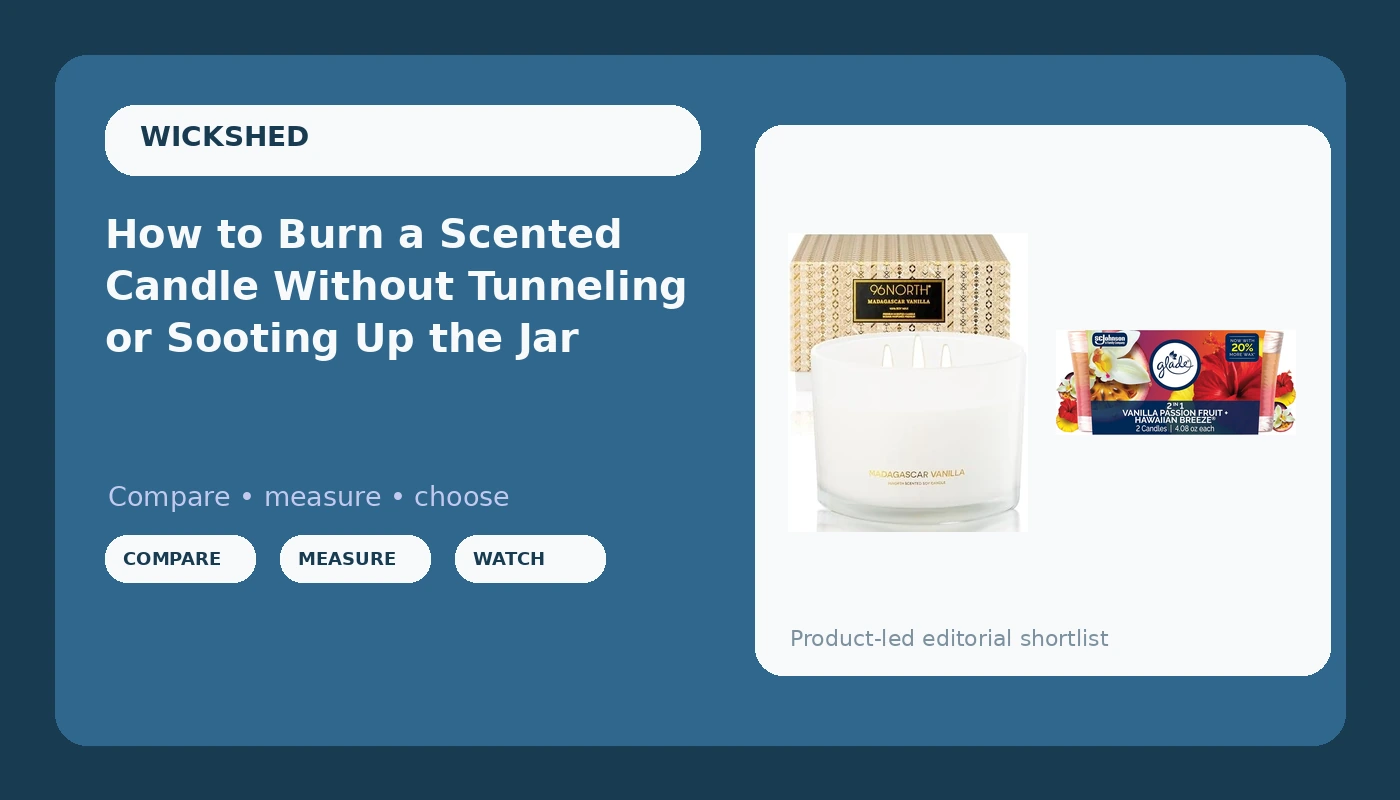
Most candles do not fail. They get failed, usually in the first two hours.
A jar gets lit for 40 minutes while dinner is on the table, blown out, relit the next night, and by the third evening there is a wax canyon down the middle and a black streak on the glass, and the candle takes the blame. It was never the candle.
Knowing how to burn a scented candle properly is not a hobbyist's obsession. It is the difference between a jar that gives you every hour it was built for and one that gives you half of them. I spent nine years in the pouring room of a contract candle factory outside Cincinnati, wicking other people's brands, and four more years selling candles over a counter at my own shop on the edge of Over-the-Rhine. The question I answered most was never "which candle." It was "why does mine look like this."
So here is the whole method, start to finish: the trim, the first burn, the four-hour rule, the extinguish, and the signs that a jar is finished. The two candles I use as examples below sit at opposite ends of the size range, a small single-wick two-pack and a large three-wick soy jar, because between them they cover almost every jar in a normal house.
Why you should trust me
Nine years in a contract pour room teaches you that a candle is a wax, a wick, and a fragrance that have to agree with each other, and that the label is the last thing worth reading. We poured the same soy-paraffin blend into a dozen different jars a day and let other people's brands take the credit for it.
I learned wicking from a laminated chart on the wall and from a foreman named Ray, who could identify a wick by running it between his fingers and would not let anyone near a pouring pot until they could read that chart. When the factory shrank in 2018 I took the severance and opened a 300-square-foot candle shop, pouring my own soy in the back and stocking other makers' jars up front. The shop lasted four years. The burn journal outlived it.
That journal is why this article exists. Every candle I write about has 50 or more logged burn hours behind it, burned across multiple three to four hour sessions, in a closed 12x12 room, with a stopwatch, a notepad, and a ruler for flame height. I do not write up a candle from a 20-minute sniff, and I do not trust a label that says "fills the room" without a number attached.
How I picked and how I tested
The method is the same for every jar, which is what makes it teachable. This is the protocol behind every entry in the journal:
- The room: closed 12x12, no ceiling fan, no open window, thermostat steady. Scent travels through still air, and moving air is a liar.
- The trim: a quarter inch, every burn if I am being good, every other burn in real life.
- The first burn: stopwatch on, no interruptions, and I do not blow it out until the melt pool has reached the edge of the jar.
- The readings: hot throw at hour one and again at hour three, judged from across the room, never with my nose hovering over the wax.
- The damage report: flame height with a ruler, mushrooming on the wick, soot streaks on the glass, and whether the wick has drifted off center.
- The math: total burn hours divided by what the jar cost. Price per burn hour is the only honest comparison between two candles.
Cold throw and hot throw are different candles. Cold throw is how a jar smells unlit with your nose an inch from the wax. It is the cheapest way to judge a candle and the least honest one, because hot throw is the whole game.
The two jars I use as examples here are a small single-wick two-pack for quick burns and a large three-wick soy jar for long evenings. The steps below apply to both. What changes is the wick count and how long the first burn takes to reach the edge.
The two jars I use in this walkthrough
One small, one large, one wick, three wicks. If you can burn these two well, you can burn anything in the aisle.
The small-jar pick: Glade 2in1 Scented Candle, Hawaiian Breeze & Vanilla Passion Fruit, 2 Count | Air Freshener Candles with Essential Oils, Tropical Home Fragrance, 2 Single-Wick Jars, 4.08 oz, Scented Candles for Home
 Visit on Amazon →
Two 4.08-ounce single-wick jars, Hawaiian Breeze and Vanilla Passion Fruit, with essential oils in the blend. This is the format I hand to people who burn candles in short windows. A small jar comes up to a full melt pool faster than anything larger, which makes it forgiving on the first burn, and that is the single biggest advantage of a small single-wick candle.
One wick means one trim instead of three, and a jar this size sits on a nightstand without taking over the surface. The tropical pairing is a warm-weather scent, which is exactly when you want a candle you can light for an hour after work and not think about again.
What to watch: a jar this size can go from a clean burn to a hot, sooty one if you push past four hours, because there is less wax to feed the flame. Burn it in two to three hour stretches, and trim before every relight. Check current Amazon price.
Flaws but not dealbreakers: The throw is sized to the room. A four-ounce jar is a bedroom or bathroom candle, not a great-room candle, and expecting it to carry a 20-foot space is a setup for disappointment.
Best for weeknight burns, bathrooms, small bedrooms, and anyone who wants a tropical scent without committing to a large jar.
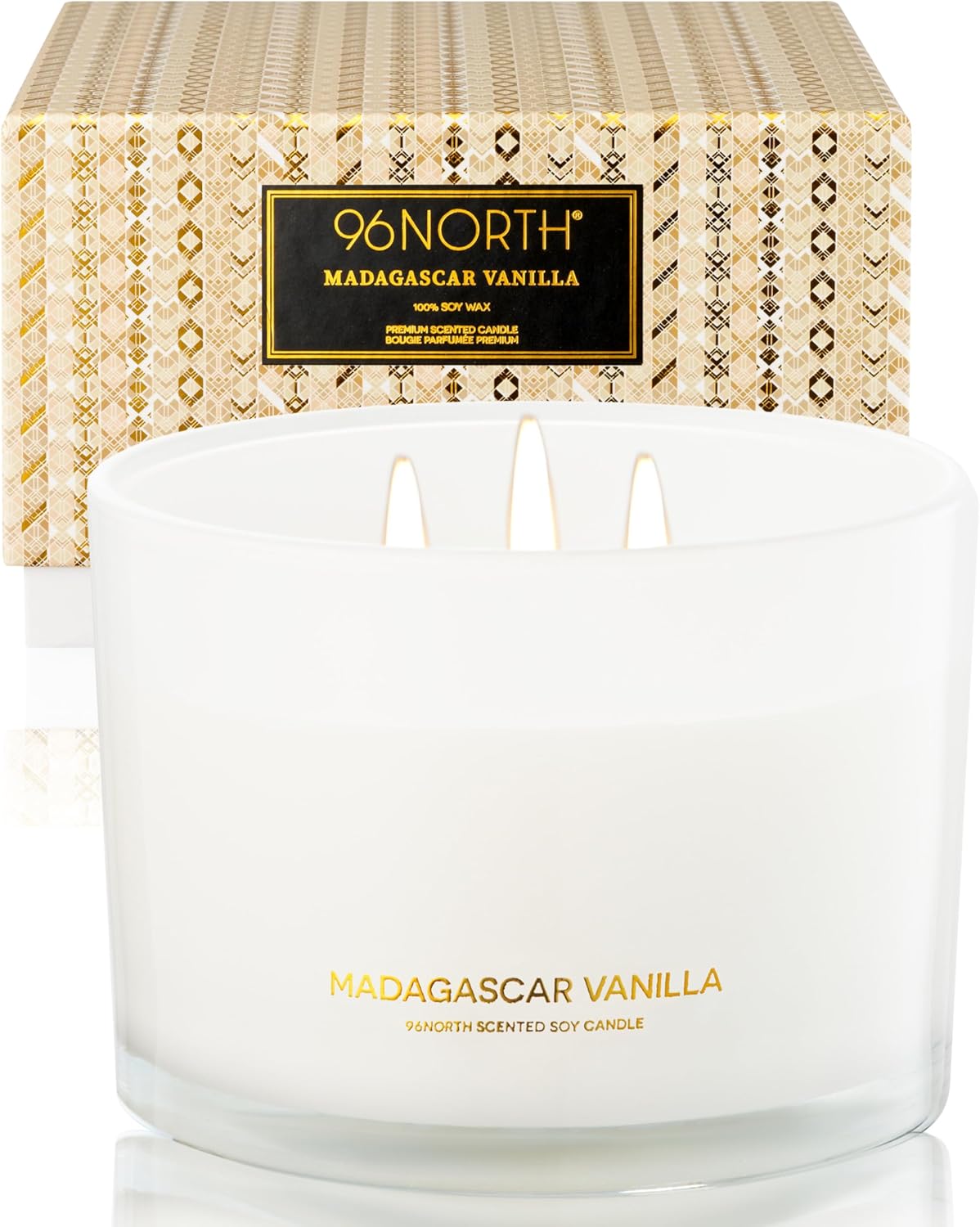
The long-burn pick: 96NORTH Luxury Vanilla Soy Candles | Large 3 Wick Jar Candle | Up to 50 Hours Burning Time | 100% Natural Soy Wax | Relaxing Aromatherapy Aesthetic Candle | Housewarming Gift for Men and Women
 Visit on Amazon →
A large three-wick jar in 100% natural soy wax, rated up to 50 hours of burn time, and packaged as a housewarming gift. Three wicks is the format that demands the most discipline, because you have three chances to tunnel instead of one. Each wick builds its own melt pool, and if the outer wicks are trimmed shorter than the middle one, the jar melts unevenly and you end up with standing wax walls.
Trim all three to the same quarter inch, every time. That single habit is the difference between a jar that lasts its rated hours and a jar that dies at hour twelve with a ring of wasted wax around the glass.
Soy burns cooler than paraffin, which gives you a gentler flame and a softer hot throw. It also means the first burn matters more, not less. A soy jar that reaches a full melt pool on the first burn usually holds that pattern for the rest of its life. One that gets cut short tunnels and never recovers.
Rated at up to 50 hours, this is the jar I would put on a living room coffee table. Check current Amazon price.
Flaws but not dealbreakers: Three wicks means three trims, and a large soy jar wants a long first burn, so do not start it at 10 p.m. if you plan to be asleep by 11.
Best for living rooms, gifting, and anyone who wants a long, gentle vanilla burn rather than a hard-hitting scent.
The first-burn workflow, step by step
Step one: trim before you light anything. A quarter inch of wick, no more. If there is a carbon ball on the tip, that is mushrooming, and it will dim your flame, weaken your throw, and paint soot down the glass. Pinch it off with a tissue or snip it with kitchen scissors, which is what I use despite telling everyone else to buy a wick trimmer.
Step two: pick the room before you pick the match. A candle throws into still air. Drafts from an HVAC vent, a ceiling fan, or an open window make the flame dance, burn unevenly, and soot. If the flame is leaning, the candle is losing.
Step three: the first burn goes the distance. Two to three hours, until the melt pool reaches the edge of the jar. This is the rule that saves candles. Quit at 45 minutes and the wax sets with a small circle in the middle, and every burn after that follows the same small circle downward.
Step four: four hours, then out. Past four hours the wick has grown, the flame is taller than it should be, and the jar starts pulling soot. Blow it out, let it cool, trim, and relight later if you want more.
Step five: trim every burn, or at least every other one. If you cannot manage that, at minimum remove the carbon ball before each relight. Mushrooming is the most common cause of a candle that suddenly stops smelling like anything.
Step six: put it out like an adult. A snuffer or the jar's own lid. Blowing sends a puff of soot across the wax, and water is a mess that can crack warm glass.
Step seven: keep the wick centered. Wicks drift. If yours wanders, wait until the melt pool is liquid and nudge it back with a chopstick or the end of a pencil. Never with a finger.
Step eight: know when the jar is done. When the wax is about half an inch from the bottom, or the wick is shorter than a quarter inch and drowning, retire it. Burning the last inch is how glass cracks and how a good candle ends on a bad note.
When the throw is weak, check these five things
The wick is too long. A tall, dancing flame burns hot and fast and pushes scent up and out of the room. Trim it back and the throw usually returns within ten minutes.
The wick is drowning. If the flame is tiny and guttering in a pool of wax, the wick is too short or too small for the jar. That is a wick problem, not a wax problem, and no amount of extra burn time fixes it.
The room is wrong. A candle rated for a bedroom will not fill an open-plan kitchen, and a drafty room carries scent away before you register it. Close the door.
You are nose-blind. After 20 minutes in the same room you stop registering a scent. Leave for ten minutes and come back. The candle was working the whole time.
The jar has tunneled. If you have wax walls, the flame is spending its energy melting sideways instead of throwing. Wrap the jar in foil with a small opening at the top and burn it for two or three sessions. It will even out.
If you want fragrance without a flame, a warmer lamp melts the top inch of wax and gives you a gentler throw, no soot, and no mushrooming. It is a real category, not a compromise, and it is the honest answer for bedrooms, apartments with smoke detectors that hate you, and anyone with pets or kids. It will never replace a match for me.
The competition and why it lost
The method above is for jar candles, because jars are what most people buy, and the rules do not transfer cleanly to everything else on the shelf.
Pillars burn straight down and want a different trim and a longer first burn to build a melt pool wide enough to keep the shell from hollowing out. Tins get hot on the sides and can scorch a table, so they need a coaster and a shorter session. Wood-wick jars crackle nicely but need the burnt tip pinched off, not trimmed, and they are fussier about draft than cotton.
Beeswax pillars are the cleanest burn I have logged, with no added fragrance and no soot, but you are getting the honey smell of the wax itself and nothing else. Paraffin-heavy blends throw harder and further than most soy, at the cost of more frequent trimming and more soot if you neglect it. None of those formats are wrong. They just are not this walkthrough.
What this all costs
I am not going to quote prices, because they move and the listings have that covered. Check current Amazon price on each jar before you decide.
What I will give you is the math that actually matters: total burn hours divided by what you paid. A large three-wick soy jar rated up to 50 hours is a straightforward calculation. A small two-pack is a different one, because each jar burns fewer hours but also costs less per jar, and the two-pack format means you are buying a spare.
Run the division on anything you are considering. A candle that burns clean for 50 hours beats one that soots up the glass by hour six, no matter what either one costs at checkout. That is the only comparison that has ever survived contact with my journal.
The tools cost nothing. Kitchen scissors, a tissue for the carbon ball, and 20 minutes of patience on the first burn. Your candle was built to do this. Let it.