Most candles don't die in the flame. They die in a drawer.
I have pulled jars out of closets in July that smelled like nothing at all, and I have pulled jars out of a cedar box in October that threw exactly as hard as the day I bought them. Same wax, same wick, six different months. Candle storage is the least glamorous skill in this hobby and it decides whether the jar you paid good money for is a candle next fall or a paperweight.
I spent nine years in the pouring room of a contract candle factory outside Cincinnati before I opened the WickShed on the edge of Over-the-Rhine. In the factory we stored pallets of finished product in a climate-controlled room for a reason: wax is a sponge, and everything around it gets a vote. In the shop I watched customers buy a jar in September, love it, and come back in March complaining that the second one "smelled weaker." It didn't. It sat in a hot car, then a hot garage, then a hot closet, and by the time the wick met a flame the top inch of fragrance had already left the building.
Here is how I store my own stash, what I store it in, and where most people go wrong.
Why you should trust me
I poured soy-paraffin blend for other people's brands for nine years, learned wicking from a laminated chart on the wall and a foreman named Ray who could identify a wick by running it between his fingers, and then spent four years selling candles over a counter and answering the same question a hundred times a week: which one should I buy?
The answer came from the burn journal. Every candle I recommend has 50 or more logged burn hours behind it, burned in a closed 12x12 room with a stopwatch, a notepad, and a ruler for flame height. I measure hot throw at hour one and again at the halfway mark, and I write down soot and mushrooming by hour four. Storage is the other half of that journal. I keep dated jars, I keep the lids, and I know exactly which scents survived a summer in the closet and which ones didn't.
How I picked and how I tested
This is a storage guide, so there are two things in play: the candle being stored and the thing doing the storing. I didn't go shopping for a "candle storage system," because that category is mostly repackaged sweater boxes and plastic totes. I went looking for a container that seals, holds a large jar plus a few tins, doesn't add a competing smell, and survives a basement.
What I check on a storage container is boring and specific. Does the lid stay on when the box is stacked? Do the clasps actually hold, or do they pop the first time you lift it by the handle? Does the material have an odor of its own? Does the size make sense for the jars you actually own, which for most people means one or two 22oz large jars and a scattering of small tins?
For the candle itself, the storage test is simpler. The jar has to be worth storing in the first place, which means a clean burn and a real hot throw, and the lid has to be the kind you keep. Glass lids are storage. Tin lids are storage. A plastic clamshell is packaging, and packaging goes in the recycling.
The habits that protect the wax you're about to put away are the same ones that protect it while it burns: a wick trimmed to a quarter inch, a first burn that lets the melt pool reach the edge of the jar within two to three hours, and no session longer than four hours at a stretch. A candle that tunnels in October will still be tunneling in March.
What candle storage actually requires
Four things, and none of them are expensive. Dark, because light fades fragrance oils and discolors wax. Cool and stable, because heat is the enemy and temperature swings are its accomplice. Sealed, because wax absorbs ambient odors and gives its own scent away to the air. And off the floor, because basements wick moisture and candles do not like moisture.
That's the whole spec sheet. Everything below is just how I meet it.
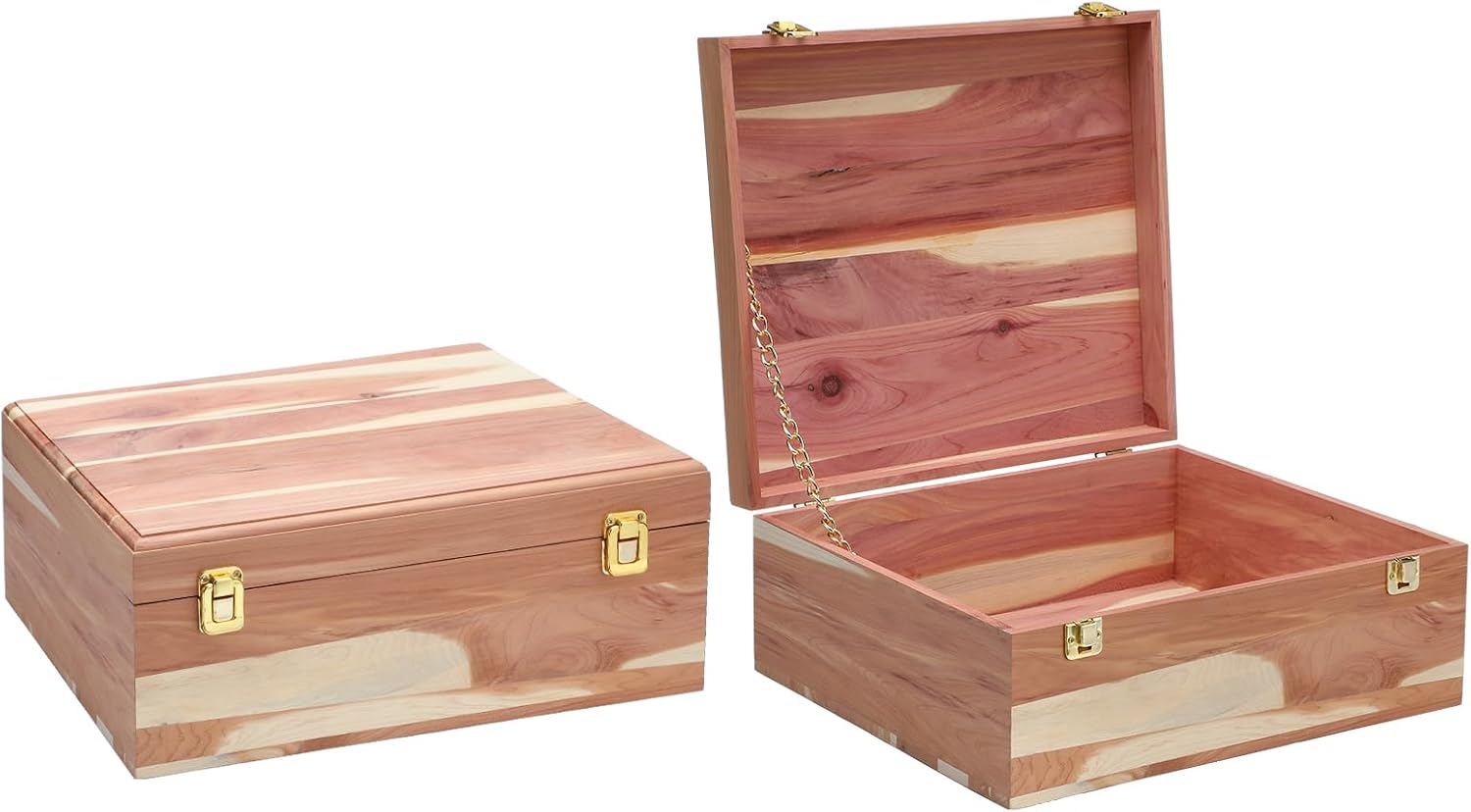
The box: Sawysine 14.2 x 12.6 x 5.9 Inch Cedar Sweater Storage Box with Lid, Dual Clasps and Hinge
 Visit on Amazon →
This is a cedar chest in miniature, and it's sold for sweaters, blankets, and clothes, which tells you the manufacturer was thinking about moth protection and not about candles. I'm recommending it anyway, with one honest caveat, because the dimensions are right for a candle stash and the dual clasps mean the lid actually closes.
Fourteen and a half inches long, twelve and a half wide, and just under six deep. That's a 22oz large jar standing upright with room beside it for four or five small tins, or a couple of pillars laid on their sides. The hinge means you open it with one hand while the other hand is holding a candle, which sounds like a small thing until you've juggled a lid on a shelf at eye level. The cedar aroma is real and it's part of the product.
Here's the caveat, and I'd rather you hear it from me: cedar smells like cedar. That's the entire point when you're storing wool, and it's a complication when you're storing wax. My rule is simple. Anything going in for a month or two of rotation goes in bare, because a cedar note drifting through a balsam candle is not a tragedy. Anything going in for a full season goes in a sealed bag first, or doesn't go in at all.
Flaws but not dealbreakers: The cedar scent is not neutral and it never goes away. If you want a scent-free box, this is not it, and no amount of airing out will change that.
Anyone with a small, rotating collection and a cool closet shelf will get real use out of this. If you're storing thirty jars, you need shelving, not a box.
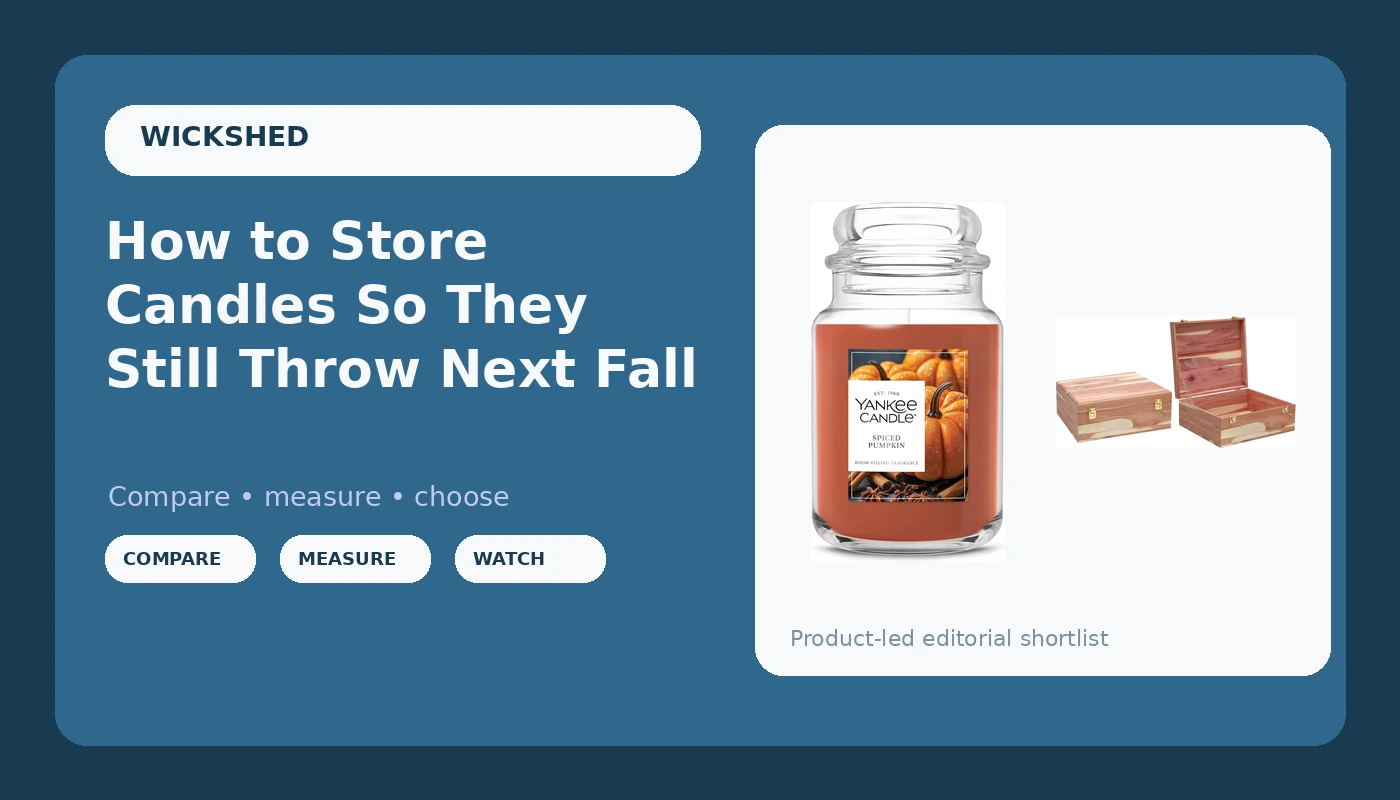
The candle: Yankee Candle Spiced Pumpkin, Fall Scented Candle, 22oz Large Jar with up to 150 Hour Burn Time, Giftable
 Visit on Amazon →
Yankee's large jars are still the throw kings for the money, and I say that as someone who pours soy in her own kitchen. The blend is paraffin-heavy, which is exactly why it carries scent across a room the way it does, and why the hot throw is consistent from hour one instead of blooming at hour three and quitting by hour ten. The label claims up to 150 hours. My journal on Yankee large jars has never been shy about logging 110-plus.
Spiced pumpkin is the one I store on purpose. It's a fall scent that people want in October and can't find in February, and the glass jar with the glass lid is the best storage container you already own.
Two things about keeping this one. First, trim the wick every other burn or it mushrooms, and a mushroomed wick sheds carbon into the wax while it sits. Second, keep the lid. A Yankee large jar with its lid on, sitting in a cool dark closet, is a candle that will throw in eleven months. The same jar with the lid lost is a jar that will smell like dust by spring.
Flaws but not dealbreakers: The paraffin blend soots if you let the wick run long, and that soot streaks the inside of the glass. Trim it and it burns clean. There's no way around the maintenance, and no, a wick trimmer is not required. I use kitchen scissors.
Anyone who wants one jar to carry a whole room through a season, and who doesn't mind trimming a wick, is the right buyer for this one.
The candle storage routine, step by step
Step one: Burn it properly before you put it away. This is the step everyone skips. Trim the wick to a quarter inch, light it, and let the melt pool reach the edge of the jar. That takes two to three hours on a 22oz jar. Then blow it out. Never burn more than four hours at a stretch. A candle stored mid-tunnel has a wick that's already too short for the wax around it, and it will tunnel again the next time you light it.
Step two: Let it cool completely, lid off. This is the one people get wrong in the other direction. Capping a warm jar traps warm, moist air against the wax. Let it sit overnight, then put the lid on.
Step three: Cap the wax. The original glass lid is the best option. For tins and lidless jars, press a piece of plastic wrap down onto the wax surface itself, then put the jar in the box. You're trying to keep air off the wax, not to seal it hermetically.
Step four: Pick the right spot. An interior closet shelf is ideal. What you're avoiding: attics, garages, above the refrigerator, above the stove, and any shelf against an exterior wall that gets sun in the afternoon. Heat and temperature swings are what actually kill a stored candle. A candle that cycles from cold to warm and back will sweat, and that moisture shows up as a rough, discolored wax surface.
Step five: Block the light. Light fades fragrance and yellows wax. A closed box does this for free. If your candles live on open shelving because you like looking at them, at least keep them out of direct sun.
Step six: Group by scent family. Balsams and evergreens together, bakery scents together, florals together. Sealed jars don't trade much scent, but the box itself does, and a cedar box has opinions. I group mine so I can find them, and so the strong ones aren't sitting on top of the delicate ones.
Step seven: Rotate forward. Whatever has been in the box longest comes out first. My rule is nothing stays stored more than a year, because a candle is a luxury you bought to burn.
Step eight: Label the bottom. A piece of masking tape with the date and your logged burn hours. This is the entire burn journal habit in one step, and it takes ten seconds. Six months later you'll know exactly what you have and whether it was any good.
Mistakes that kill a stored candle
The freezer. This is the myth that refuses to die. Cold makes wax brittle, and a frozen jar can crack or pull the wick away from the wax at the base. Worse, wax in a freezer absorbs whatever else is in there. Never freeze a candle to make it "last longer."
The hot garage or attic. A candle that hits 100 degrees will soften, sweat, and lose fragrance. This is the single most common reason a second jar smells weaker than the first.
Storing it with a mushroomed wick. That carbon ball crumbles into the wax. Trim before you store, every time.
The dusty shelf. An open jar with a dusty wick is a smoky burn waiting to happen. Cap it.
Storing it next to cleaning products or kitty litter. Wax picks up ambient odor. It's a sponge, not a vault.
Stacking weight on pillars. Soft wax deforms under a heavy jar. Lay pillars flat, alone, or stand them with nothing on top.
The competition and why it lost
A clear plastic tote from the hardware store is the cheap answer, and it works if you line it and keep it in a cool closet. What it doesn't do is keep light out, and a clear tote in a sunny room is worse than no tote at all. The lid also doesn't seal, so dust finds its way in.
A cardboard box is free and it does block light, but cardboard carries its own smell and it doesn't survive a damp basement. I've lost jars to a cardboard box in a garage, and I don't recommend repeating my mistake.
A ziplock bag alone is fine for a single jar in a drawer. It's not a system, and stacking bags on a shelf means the wax gets pressed and the wicks get bent.
Open shelving as display is the most common approach and the worst one for anything you plan to keep past a season. It's fine for the candle you're burning this week. It's not storage.
What this all costs
Storage is the cheapest part of this hobby and the one that saves the most money. The math that matters is price per burn hour, not sticker price. A large jar that burns for well over a hundred hours at a real hot throw is a better buy than three cheap jars that go scentless in a closet, and the only thing standing between the two outcomes is whether you capped the lid and kept it out of the heat.
The box is a one-time purchase that outlives the candles in it. The lids you already have. The plastic wrap is in a drawer. The closet shelf is free.
If you buy nothing else this season, buy the candle you actually want to burn in October and then treat it like something worth keeping. Trim the wick to a quarter inch, let the melt pool reach the edge, cap it when it cools, and put it somewhere dark and cool. That's the whole job, and it's the difference between a candle that throws next fall and a jar that smells like a drawer.