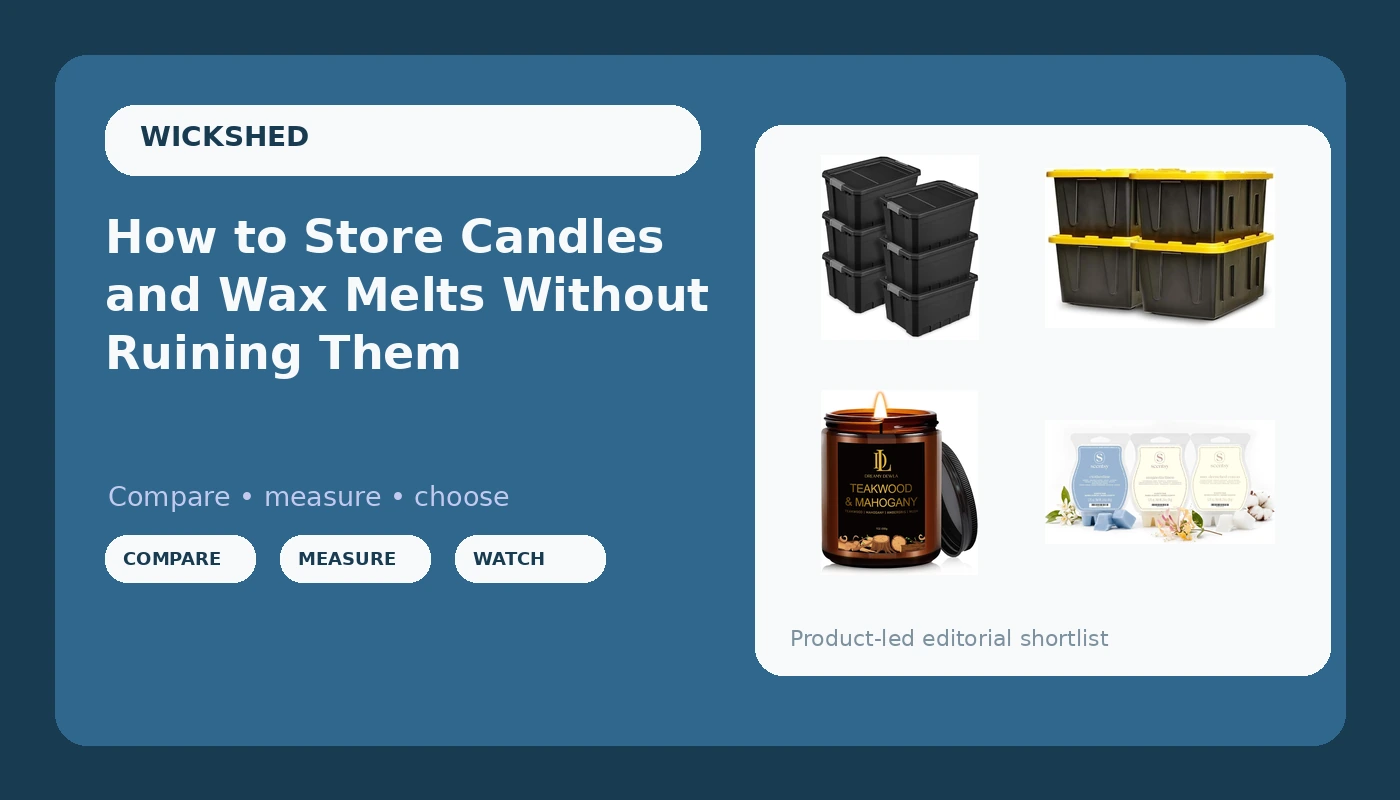
Most candle collections do not die by burning. They die in storage: a jar that sat in a sunny window all summer, a clamshell of wax cubes that lost its throw by December, a wick that bent under three other jars in a cardboard box. Candle and wax melt storage is the least glamorous corner of this hobby and the one that decides whether the candle you bought in March still smells like itself in November.
I spent nine years in the pouring room of a contract candle factory, where finished cases sat in a warehouse for weeks before they shipped, and four years behind a shop counter, where back stock lived in stacked totes under the worktable. Both places taught me the same unglamorous lesson: wax absorbs whatever its environment offers, fragrance is the first thing to leave, and the container matters more than the shelf.
Related: The First Burn Rule That Saves Every Candle →
Quick answer
Store candles upright in a closed container in a cool, dark, dry spot, and keep wax melts sealed in their original clamshells inside that same container. Lidded plastic totes handle this cheaply and stack well, which is why two sizes cover most collections: a mid-size tote for everyday jars and tins, and a larger bin for seasonal stock. None of these products makes a candle smell stronger, and none is a substitute for a correct first burn. They prevent the damage that storage causes.
Four useful options
| Model | Best fit | What stands out |
|---|---|---|
| Sterilite Stacker Tote, Plastic Storage Bins with Lids, 19 Gallon, 6-Pack | Everyday jars, tins, and wax melt bars | A six-tote pack in a mid-size footprint with lids included |
| HOMZ Durabilt Plastic Storage Bins with Lids, 27 Gal, Black/Yellow, 4 Pack | Seasonal and bulk stock | Larger 27-gallon capacity in a four-pack with lids |
| Teakwood & Mahogany Candles, Natural Soy Candles for Home Scented, 50 Hour Burn Time | A jar that earns shelf space rather than bin space | Soy wax with a stated 50-hour burn time |
| Scentsy Wax Melts, Fresh From the Line 3 Bar Set, Paraffin Wax Cubes, 7.8oz | Flameless fragrance and warmer users | Three paraffin wax bars in a 7.8oz set |
The everyday bin: Sterilite Stacker Tote, Plastic Storage Bins with Lids, 19 Gallon, 6-Pack
Nineteen gallons sounds like a lot until you start laying three-wick jars on their sides, which you should never do. A jar stored upright takes up its full diameter plus air around it, so a tote fills faster than the number suggests. What this size gets right is the middle ground: big enough for a dozen large jars or several dozen votives and tins, small enough that one person can lift it off a closet shelf without help. The lid is the whole point. Dust on exposed wax is a real problem, and a closed tote also buffers the small temperature swings that make soy wax bloom with a white film. That bloom is cosmetic, not spoilage, but it looks alarming on a gift jar. The trade-off is that a closed tote hides what is inside, so you either label it or you open three totes to find the balsam jar you wanted.
The bulk bin: HOMZ Durabilt Plastic Storage Bins with Lids, 27 Gal, Black/Yellow, 4 Pack
The jump from 19 to 27 gallons is not about candles getting bigger. It is about how much dead air you need between them. A larger bin lets you stand tall pillars and oversized jars upright with room to spare, and it swallows the odd shapes that never fit anywhere: gift sets, glass cloches, wooden lids that need to lie flat. Four bins at this size is a lot of volume, which makes this a garage or basement pick rather than a closet pick. That raises the one caveat that matters with any large bin: a damp basement is the wrong home for candles regardless of what they are sealed in. Cardboard wicks and paper labels will take on a musty note, and no lid fixes that. If your only storage space is humid, keep the collection small and keep it upstairs.
The jar worth the shelf: Teakwood & Mahogany Candles, Natural Soy Candles for Home Scented, 50 Hour Burn Time
Not everything belongs in a bin. The jars you burn this month belong on the shelf, upright, with the lid on, and this is the kind of candle that earns that spot: a soy jar with a woody scent, sized for a nightstand or a desk rather than a great room. Soy is the wax most sensitive to temperature swings, which cuts both ways here. It blooms white in the cold and softens early in the heat, but it also holds a fragrance load well when it is stored correctly, meaning the teakwood and mahogany notes have a better chance of surviving a few months of sitting. The stated 50-hour burn time is a manufacturer figure, and the only way to know what you got is to keep track of your own sessions. Treat the jar as the unit of storage: lid on, upright, out of direct sun, and it will still be worth burning in the spring.
The flameless rotation: Scentsy Wax Melts, Fresh From the Line 3 Bar Set, Paraffin Wax Cubes, 7.8oz
Wax melts are a different storage problem than jar candles, and most people get it wrong the same way: they break a bar out of the clamshell, leave the rest open on a shelf, and wonder why the last third smells like nothing in February. Paraffin holds fragrance well, but the fragrance is volatile and it leaves through any opening it can find. Keep the bars in the clamshell, keep the clamshell closed, and keep it inside the tote with the rest of the rotation. Melts also have no wick to fail, which makes them the honest answer for bedrooms, apartments with sensitive smoke detectors, and anyone with pets or small kids who would rather not have an open flame at eye level. The trade-off is throw. A warmer delivers a gentler, slower scent than a flame, and the same cubes will smell softer at hour four than a burning candle would.
Prices and availability may change. Product images, names, and retailer links must be matched by verified ASIN. Do not state a current price, rating, stock status, or measured result without current evidence.
Why storage is really a scent problem
A candle is a wax, a wick, and a fragrance that have to agree with each other, and storage is where that agreement either holds or breaks down. Fragrance oils are volatile compounds, which is a polite way of saying they evaporate. Heat speeds that up, light speeds it up, and an open container gives them somewhere to go. That is why a candle that smelled strong in the store can smell flat three months later without ever being lit. The wax itself is more forgiving. Soy can develop a white surface bloom after a cold snap, and paraffin can sweat slightly in heat, but both are cosmetic changes that a normal burn usually clears up. The wick is the part people forget. A wick that gets bent, crushed, or coated in dust will not draw wax the way it should, and a wick that will not draw is a candle that tunnels no matter how patient you are with the first burn.
Setting up a collection so it survives the season
- Sort by format first, not by scent: jars in one pile, tins in another, wax melt bars in a third. Formats have different storage needs and mixing them wastes space.
- Inspect every wick before anything goes in a bin. Straighten bent wicks, trim mushroomed tips to roughly a quarter inch, and set aside anything with a crushed or frayed wick to burn first.
- Keep jars upright and never stack them on their sides. Lying a jar down lets wax pool against the wick and against the lid, and it is the fastest way to end up with a crooked wick.
- Seal wax melts in their original clamshells, then put the clamshells inside the tote. An open bar on a shelf is a scent leak with a countdown on it.
- Label the outside of each tote with a marker and a date, and rotate the oldest stock to the front. A bin you have to open to identify is a bin you will avoid, and avoided stock is where the losses happen.
Practical guidance that actually protects a collection
- Keep storage cool, dark, and dry. A closet interior beats a garage shelf, and both beat a windowsill or a spot near a heat vent.
- Never store candles in a damp basement or anywhere with standing humidity. Wicks and paper labels absorb that smell and there is no fixing it afterward.
- Choose the smallest container that fits the job. A half-empty 27-gallon bin is mostly air, and air is what carries fragrance away.
- Separate seasonal stock from the current rotation so you are not digging through holiday jars to reach a balsam one in July.
- Expect flameless and flame to store differently. Wax melts need a tighter seal because there is no jar and no lid doing the work for them.
Which option should you choose?
Choose the Sterilite Stacker Tote, Plastic Storage Bins with Lids, 19 Gallon, 6-Pack when you want a working rotation of jars and tins stored in a closet or under a table, stacked, labeled, and easy to lift. Choose the HOMZ Durabilt Plastic Storage Bins with Lids, 27 Gal, Black/Yellow, 4 Pack when the collection is seasonal or genuinely large, and the space you have is a dry garage or basement corner rather than a closet. Choose the Teakwood & Mahogany Candles when you are buying a jar to burn now rather than to put away, and you want a soy candle with a woody scent and a stated 50-hour burn time. Choose the Scentsy Wax Melts, Fresh From the Line 3 Bar Set when you want fragrance without a flame, and you are willing to keep the clamshell closed between uses.
One caveat runs through all four: none of this is a claim about how any specific candle performs, and none of these products fixes a candle with a wick that is wrong for its jar. Storage protects what you bought. It does not improve it.
The bottom line
Candle and wax melt storage comes down to four things: upright, sealed, dark, and steady. A lidded tote handles three of them for very little money, which is why the mid-size Sterilite six-pack covers most collections and the larger HOMZ four-pack covers the seasonal overflow. The jar and the wax melts are the reminder that not everything needs a bin: keep the candle you are burning this month on the shelf with its lid on, and keep the melt bars sealed in their clamshells until the day you use them. Do that, and the candle you bought in March still smells like the candle you bought in March.