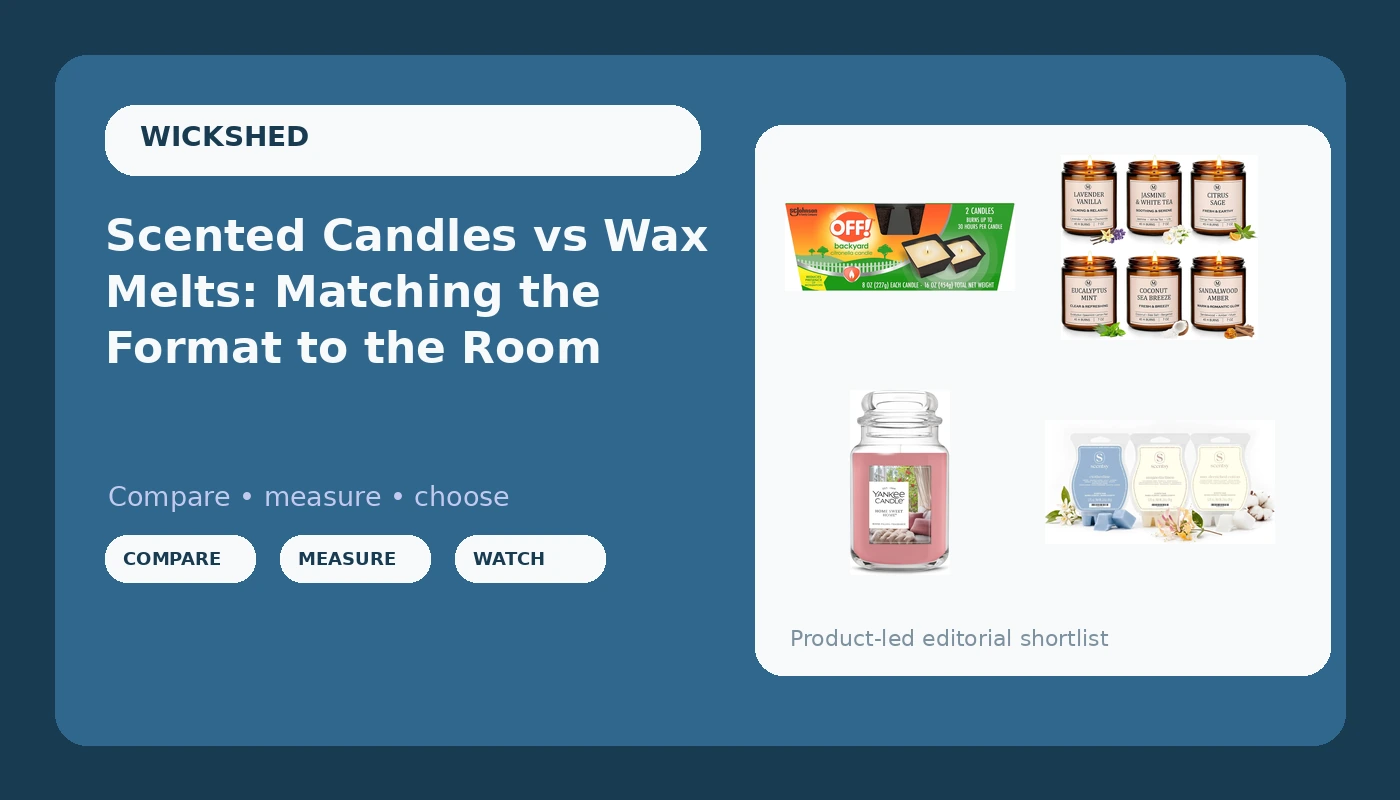
Two shoppers can walk into the same room with the same goal, cover the same square footage, and walk out with completely different products. That is because scented candles and wax melts are not two versions of one thing. A candle is a self-contained burn: wax, wick, and fragrance oil that have to agree with each other inside a jar. A wax melt is wax alone, heated from below by a warmer, with no flame and no wick to trim. The scent name printed on the front of the package tells you almost nothing about which one belongs in your space. The format does.
This is a format-first look at four options covering four different jobs: a long-burn jar for the main room, a multi-candle set for spreading fragrance around a house, an outdoor candle for a porch or patio, and a flameless option for rooms where a flame is a bad idea. Get the format right and the scent choice gets a lot easier.
Related: How to Fix a Tunneling Candle on the First Burn →
Quick answer
Match the format to the room, then pick the scent. If you want flame, ambience, and a burn you can watch, a jarred candle is the answer. If you want fragrance with no fire, in a bedroom or an apartment with twitchy smoke alarms, wax melts and a warmer are the answer. If the space is a porch, patio, or backyard, use a candle labeled for outdoor use and keep it there. Treat every burn-time figure as a maker's claim rather than a measurement: "up to 150 hours" is a ceiling that assumes a trimmed wick, a full melt pool, and short burn sessions, not an average you should bank on. None of the four options below is the right pick for every household.
Four useful options
| Model | Best fit | What stands out |
|---|---|---|
| Yankee Candle Home Sweet Home, 22 oz Large Jar | A living room or open-plan space where one jar has to carry the room | 22 oz jar, maker-stated up to 150 hours, plant wax blend |
| Scented Candles for Home, 6-Pack Soy Candle Gift Set | Spreading scent across several small rooms, or gifting | Six soy candles, maker-stated up to 300 hours across the set |
| OFF! Backyard Citronella Outdoor Candle, 8 oz (2-Pack) | Patios, porches, and backyard tables | Two 8 oz citronella candles labeled for outdoor use |
| Scentsy Wax Melts, Fresh From the Line 3 Bar Set | Bedrooms, rentals, and anywhere a flame is unwelcome | 7.8 oz of paraffin wax cubes, no wick and no flame |
The long-burn jar: Yankee Candle Home Sweet Home
A jar this wide is where first burns go wrong. The melt pool has to reach the glass edge within two to three hours, or the candle sets a memory of the smaller circle and tunnels for the rest of its life. That is not a defect, it is heat transfer: a wick can only push its melt ring so far in one session. Run this one for three to four hours on the first lighting, in a room with no draft, and the wick will have the pool it needs. The wide jar is also why this format rewards patience and punishes the twenty-minute test burn. And when you compare it to anything else, do the division: stated hours against cost is the only honest way to compare a big jar with a box of small ones.
The multi-room set: Scented Candles for Home 6-Pack
The trade-off is throw. A small jar with a small wick will not carry a big room the way a 22-ounce jar can, so place these where you will actually be sitting rather than expecting one to scent an open-plan living space. The other trade-off is consistency: with six candles in a box, check wick placement on each one before the first burn, because a wick set off-center will tunnel no matter how carefully you trim it. Sets like this are also the format most likely to be bought as a gift, which means the recipient, not you, controls the first burn. A short note in the box about trimming and the two-to-three-hour first session does more for the candle than any ribbon.
The outdoor option: OFF! Backyard Citronella Candle
Do not judge this one by indoor throw standards. Moving air, open space, and distance from where you are sitting all work against any candle outdoors, and a citronella candle's value is as much about the ritual of a lit table as it is about the scent. Keep it outside, keep it out of the wind, and keep it clear of anything that can catch. If what you actually want is fragrance inside the house, this is the wrong tool, and no amount of it on the deck will fix that.
The flameless format: Scentsy Wax Melts
The catch with any melt is that the wax does not disappear the way a candle does. The fragrance oil burns off first, so the scent fades while the wax is still sitting in the dish. Pour it off, wipe the bowl, and start a fresh cube. Flameless also means gentler: a warmer will never throw the way a wide, hot-burning jar throws, which is a fair trade in a bedroom or a rental with a stubborn smoke detector, and a poor trade in a large open room where you want scent to travel. Check the height adjustment on whatever warmer you use before trusting it with wax you like.
Prices and availability may change. Product images, names, and retailer links must be matched by verified ASIN. Do not state a current price, rating, stock status, or measured result without current evidence.
How burn-time claims actually work
A burn hour is not a fixed unit. The number on the box comes from a test the maker runs under favorable conditions: a trimmed wick, no draft, and sessions short enough that the wax never overheats. Change any one of those and the number moves. The biggest drivers are the mass of wax, the diameter of the jar, the size of the wick, how long each session runs, and whether anyone bothers to trim. That is why two candles of the same weight can honestly carry different hour counts, and why "up to" is doing real work in every one of those claims.
It also helps to separate cold throw from hot throw. Cold throw is how the candle smells unlit, with your nose near the wax. Hot throw is how it smells while burning, judged from across the room. Cold throw is the cheapest thing to test in a store and the least predictive of what you will actually live with, because a candle that smells wonderful in the jar can go quiet the moment the wick lights, and a candle that smells flat cold can open up at hour one. Judge by hot throw, and judge it in the room where the candle will live.
Why the first burn decides the candle
A candle's first session sets its behavior for the rest of its life. Wax has a memory. If the melt pool only reaches an inch out from the wick before you blow it out, the next burn tends to follow the same ring, and the wax walls left standing never catch up. That is tunneling, and it is almost always a wick and patience problem rather than a bad batch of wax. Give the first burn two to three hours, long enough for the pool to reach the edge of the glass, and you have effectively trained the candle.
The other half of the first burn is wick length. A quarter inch is the working number. Longer and the flame gets tall and smoky; shorter and it drowns in its own melt pool. Mushrooming, the carbon ball that forms on an untrimmed tip, dims the flame, weakens the throw, and streaks soot down the glass. None of that is a reason to throw a candle away. It is a reason to buy a trimmer, or to use the kitchen scissors like everyone else.
- Measure the room and pick the format before you pick a scent. A 22-ounce jar for a big room, small candles for small rooms, a warmer for rooms without a flame, an outdoor candle for outdoor space.
- Decide whether you want fire in the room at all. This one question eliminates half the catalog.
- Read the wax, the wick, and the jar diameter together. A wick that is undersized for the diameter is the single most common cause of a candle that tunnels.
- Plan the first burn before you light anything: trimmed wick, no draft, two to three hours, and a clear edge to the melt pool.
- Run the math last. Stated hours against cost gives you a rough cost per burn hour, which is the only comparison that survives contact with a full jar.
Practical guidance
- Trim to a quarter inch before every burn, or at minimum every other burn, and never leave a mushroomed tip in place.
- Cap any session at about four hours. Past that the wax overheats, the wick grows, and soot starts landing on the glass.
- Keep candles out of drafts and away from vents. A dancing flame burns unevenly and eats the wax on one side.
- For wax melts, start with one cube rather than filling the dish. You can always add fragrance, but you cannot take it out of the air.
- Place small candles where you sit rather than where you walk. Throw is a distance, not an adjective, and a six-ounce jar will not carry a hallway.
Which option should you choose?
Choose the Yankee Candle Home Sweet Home 22 oz Large Jar when one candle has to handle a living room, a dining area, or any space where you want the longest maker-stated burn time and a wide vessel that sets a proper melt pool. Choose the Scented Candles for Home 6-Pack Soy Candle Gift Set when you want fragrance in several small rooms at once, or when you need a gift that does not require a warmer. Choose the OFF! Backyard Citronella Outdoor Candle when the space is a patio, porch, or backyard table and the candle will live outdoors. Choose the Scentsy Wax Melts 3 Bar Set when you want fragrance without a flame, in a bedroom, a rental, or a home with pets and small kids, and you already own or plan to buy a warmer.
One caveat that applies to all four: burn-time figures are manufacturer claims, not independent measurements, and no one can promise you a specific hour count in your house. Room size, ceiling height, air movement, and how faithfully you trim will move the result more than the label will.
The bottom line
The format question comes first and the scent question comes second, and getting that order right prevents most candle disappointment. A wide jar rewards patience with a long burn, a multi-candle set spreads modest fragrance across several rooms, a citronella candle belongs outdoors and nowhere else, and wax melts trade flame and throw for control and safety. Check the wax, check the wick against the jar, commit to a real first burn, and treat every hour count on a label as the ceiling rather than the promise.