The candle shelf splits into two camps and almost nobody explains the difference. On one side you have scented and unscented candles sold side by side at similar prices, and on the other you have a wall of labels making claims about wax, wicks, and burn hours that were written by a marketing department, not a pour room. A 9 oz coconut vanilla jar and a six-pack of plain white pillars can sit three feet apart and have nothing in common: one is a fragrance delivery system, the other is a light source that happens to look good on a mantel.
That confusion is the reason most people buy the wrong candle. They want a scent and come home with decor. They want something for a power outage and come home with a $30 jar they are afraid to burn. Or they buy a scented candle, burn it for forty minutes, blow it out, and blame the candle when it tunnels two weeks later.
Here is the honest version, sorted by what you actually need the candle to do. No wax sermon, no "fills the room" promises, just the specs on the label and the way a candle behaves when you light it.
Related: The First Burn Rule: Why Most Candles Fail in Hour One →
Quick answer
Buy a scented jar candle when you want fragrance, and buy unscented pillars when you want light, height, or a candle that can sit in a drawer for two years without losing anything. Scented jars carry a fragrance description and a stated burn time, which lets you compare one against another. Unscented pillars carry no fragrance oil at all, so their job is flame and form: wedding tables, windowsills, blackout kits, and centerpieces that will not fight the food.
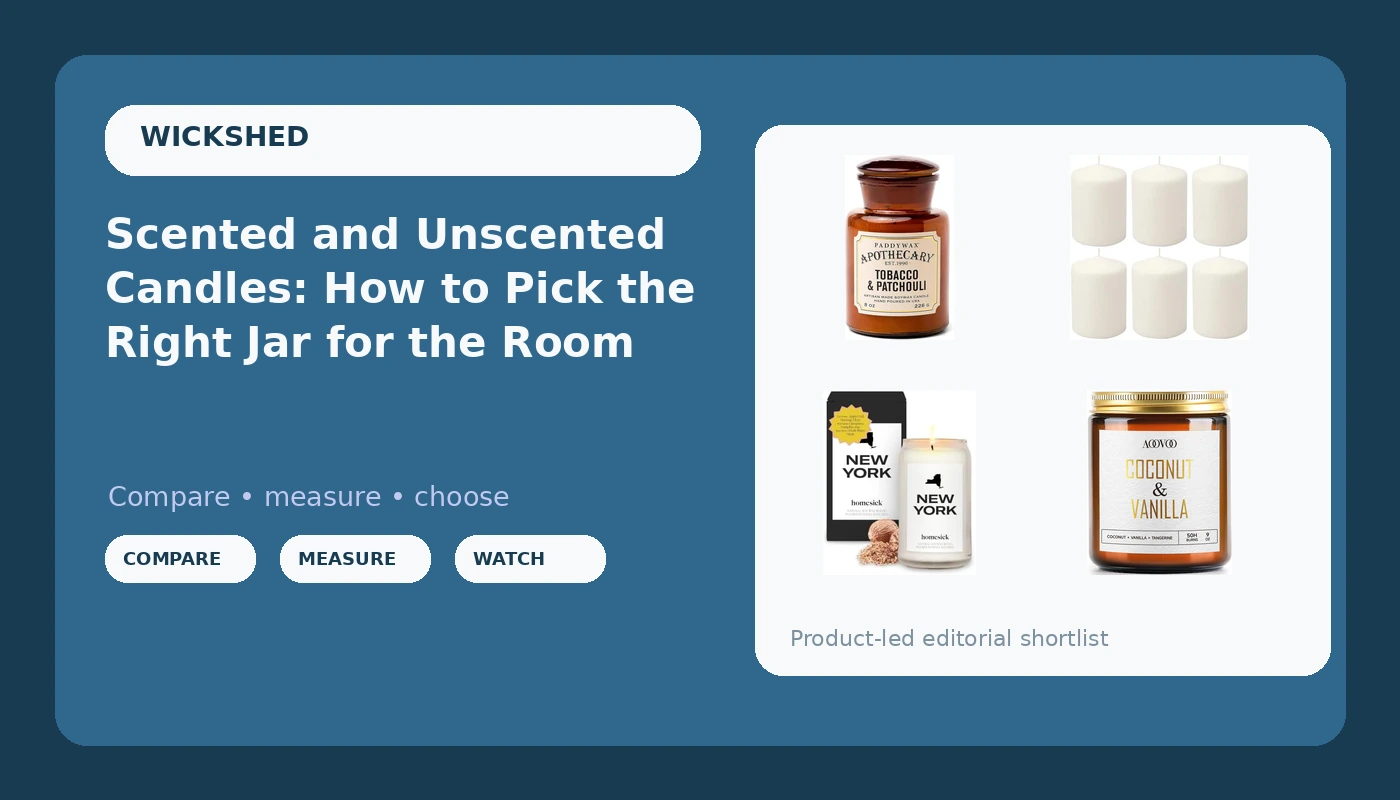
The four candles below cover four different jobs: a city-themed soy jar built around scent memory, a tobacco and patchouli soy candle in a lidded glass jar worth keeping, a smaller coconut vanilla jar for everyday burning, and a six-pack of unscented white pillars for the practical shelf.
Four useful options
| Candle | Best fit | What stands out |
|---|---|---|
| Homesick Scented Candle (New York) | Gifting and scent memory | 13.75 oz soy wax jar, 60 to 80 hours stated burn time, notes of nutmeg, cinnamon and clove |
| Paddywax Artisan Apothecary, Tobacco & Patchouli | Reusing the vessel | 8 oz soy candle in a lidded glass jar, approx. 54 hours stated burn time |
| AOOVOO Coconut Vanilla Candles | Everyday scent in a smaller jar | 9 oz scented jar, coconut and vanilla |
| Stonebriar Unscented White Tall Pillar Candles | Decor, weddings, emergencies | 3" x 4" pillars, 35 hours stated burn time, six per pack, no added fragrance |
The gift with a memory attached: Homesick Scented Candle (New York)
The Homesick line is a souvenir first and a candle second, and that is not a knock. Scent memory is real, and a jar that smells like a specific place does something a generic vanilla jar cannot. The nutmeg, cinnamon and clove profile here is warm and spice-forward rather than fresh or floral, which makes it a natural fit for fall and winter gifting and a strange fit for anyone who wants a clean linen smell in July.
Two things to keep in mind. First, a 13.75 oz jar is a big vessel, so the first burn matters more than usual: if you quit at forty minutes, you will tunnel a jar that size and lose a good chunk of that stated burn time. Second, city-themed candles trade some throw for concept. Judge it on how it smells while burning, not on how it smells with your nose in the jar, because those are two different candles.
The reusable vessel: Paddywax Artisan Apothecary, Tobacco & Patchouli
This is the one on the list where the packaging is half the purchase, and I mean that as a compliment. A thick glass jar with a real lid is worth something after the wax is gone: cotton balls, q-tips, hair ties, loose change, a small plant. The lid also does quiet work while the candle is alive, since covering a jar between burns keeps dust off the wax and holds the fragrance in.
Tobacco and patchouli is a love-it-or-leave-it profile. It reads as smoky, earthy and slightly sweet, closer to a library or a leather chair than to a bakery. If you want something light and dessert-adjacent, this is the wrong jar. If you want a candle that makes a room feel finished, this is the one. The stated burn time of about 54 hours is a manufacturer estimate, and like every estimate on this page it assumes trimmed wicks and sessions of three to four hours, not a nine hour marathon.
The everyday jar: AOOVOO Coconut Vanilla Candles
Coconut and vanilla is the safest fragrance on this list and the one I would hand to someone who says they do not know what they like. It is sweet without being a dessert, and it works in a bathroom, a bedroom, or on a desk where a heavy tobacco scent would be too much. The 9 oz format is the practical part: a smaller jar is easier to burn all the way through, which means fewer half-finished candles sitting on shelves because someone got bored.
The trade-off is reach. A 9 oz jar in a large open living room with high ceilings will struggle to make itself known, and no amount of wick trimming fixes a jar that is simply too small for the space. Put it in a closed room and it behaves very differently. This is also the kind of candle where the cold throw flatters it, so buy it expecting a gentler hot throw rather than a room-filling one.
The practical shelf: Stonebriar Unscented White Tall Pillar Candles
Unscented is a feature, not a compromise. A plain white pillar does not compete with dinner, does not fight a scented candle burning in the next room, and does not lose its fragrance after two years in a closet, because there is no fragrance to lose. Six pillars at 3 by 4 inches each with a stated 35 hours per candle gives you a lot of hours of light in a form that looks intentional on a table.
Pillars behave differently from jars and deserve different habits. They need a holder or a plate, they drip if they sit in a draft, and the classic pillar trick is to burn them long enough to form a well, then hollow out the center and drop a tea light in so the shell keeps glowing without the wick. Never leave a burning pillar unattended, and never burn one near curtains or anything that can catch a draft.
Prices and availability may change. Product images, names, and retailer links must be matched by verified ASIN. Do not state a current price, rating, stock status, or measured result without current evidence.
What the label actually tells you
Wax is the first line and the least useful one on its own. Soy, paraffin, beeswax and blends all burn, and each has quirks: soy tends to burn cooler and slower, paraffin throws fragrance harder in most blends, beeswax burns clean and smells faintly of honey with nothing added. None of that tells you whether a specific candle is good. What tells you is the combination of wax, wick, jar diameter and fragrance load, and only the first two or three of those usually appear on the label.
Burn time claims are estimates, and they assume a specific set of habits: a trimmed wick, sessions of roughly three to four hours, and no drafts. A 60 to 80 hour claim on a 13.75 oz jar is a range because the manufacturer knows the same thing you should know, which is that burn time depends on how you burn it. A 35 hour pillar and a 54 hour jar are not directly comparable either, because pillars and jars consume wax at different rates.
Fragrance load is the number nobody prints. More fragrance oil is not automatically better. Past a certain point, extra oil stops adding throw and starts adding soot, a wick that struggles to stay lit, and a scent that turns sharp and chemical at hot throw. This is why a cheap candle can smell great cold and terrible burning, and why the only honest test is the one you run at home.
The unscented label on the Stonebriar pillars means no fragrance oil was added. It does not mean the wax is odorless, and it does not mean the candle is "cleaner" in any meaningful sense. It means the candle has one job, which is light.
How the first burn decides everything
Most candles that get called defective were failed in the first two hours. The first burn sets the melt pool memory of the wax: get a full pool to the edge of the jar and every later burn follows that circle, quit early and the candle learns to tunnel and never unlearns it.
That is why the first burn should run two to three hours, long enough for the melted wax to reach the glass on all sides. Trim the wick to about a quarter inch before you light it, and again before every burn after that. A wick that is too long mushrooms into a carbon ball, which shrinks the flame, dims the throw, and streaks soot up the glass. A wick that is too short drowns in the melt pool and the candle goes out.
Here is the order I would work through when deciding what to buy and how to burn it:
- Decide what the candle is for. Fragrance, light, decor, or an emergency kit. Everything else follows from that.
- Match the jar size to the room. A 9 oz jar belongs in a closed room; a 13.75 oz jar can carry a larger space.
- Read the wick and wax description against the jar diameter. A wide jar with a thin wick is a tunneling problem waiting to happen.
- Translate the stated burn time into sessions. Divide by three or four hours to get a realistic number of evenings.
- Plan the first burn before you light it. Trim, clear two to three hours, and do not stop until the melt pool reaches the edge.
Practical guidance
- Trim the wick to about a quarter inch before every burn. Kitchen scissors work fine.
- Cap sessions at four hours. Longer burns heat the jar, over-melt the wax, and push the wick past what it can handle.
- Keep candles out of drafts. A dancing flame burns unevenly, soots the glass, and wastes wax.
- Always set pillars on a holder or a plate, and never leave any candle burning unattended.
- Cover jar candles with their lid between burns to keep dust out and fragrance in.
- Judge a scented candle while it is burning, not with your nose in the cold wax.
Which option should you choose?
Choose the Homesick Scented Candle (New York) when you are buying a gift for someone with a connection to a place and you want the jar to mean something before it is even lit. Choose the Paddywax Artisan Apothecary, Tobacco & Patchouli when you want a warm, smoky, earthy scent and a thick lidded jar you will actually reuse. Choose the AOOVOO Coconut Vanilla Candles when you want an easy, sweet, everyday scent for a bathroom, bedroom, or desk. Choose the Stonebriar Unscented White Tall Pillar Candles when you need light and form rather than fragrance, whether that is a wedding table, a windowsill, or a drawer of emergency supplies.
The caveat worth repeating: every burn time on this page is a manufacturer estimate, not a measured result, and it assumes trimmed wicks and moderate sessions. Room size, ceiling height, drafts, and how long you actually burn a candle will move that number in either direction. Scent strength is even more subjective, which is why a candle that smells perfect in one house can seem faint in another.
The bottom line
Scented and unscented candles are not competing versions of the same product, so stop comparing them on one shelf. Scented jars, whether it is coconut vanilla at 9 oz or nutmeg, cinnamon and clove in a 13.75 oz soy jar, are fragrance delivery systems with a stated burn time you can compare. Unscented pillars are light and shape, with nothing to fade and nothing to compete with. Pick the job first, then pick the jar, then treat the first burn like it matters, because it does.