Most people stand in front of a candle shelf with two products in mind and no way to compare them: the scented candles and unscented pillars sitting a few feet apart. They look like the same object in different packaging. They are not. One is a fragrance delivery device with a wax and wick problem attached. The other is a light source with a wax and wick problem attached. The tests that tell you whether either one is any good are completely different tests, and that is the whole reason choosing between scented candles and unscented pillars trips people up.
I spent nine years in the pouring room of a contract candle factory outside Cincinnati, pouring the same soy-paraffin blend into a dozen different jars and letting other people's brands take the credit. I learned wicking from a laminated chart on the wall and a foreman named Ray who could identify a wick by running it between his fingers. I learned that "premium" on a label is a sticker, not an ingredient. When the factory shrank in 2018 I took the severance, opened a 300-square-foot shop called the WickShed, and started burning every candle I stocked at home in a closed 12x12 room with a stopwatch, a notepad, and a ruler.
Here is the honest version of what that journal taught me, and how to apply it to a scented set and an unscented pillar before you spend anything.
Why you should trust me
The shop lasted four years. The burn journal outlived it, and it is the reason this site exists. Every candle I recommend here has 50 or more logged burn hours behind it, across multiple three to four hour sessions, with flame height noted and soot streaks photographed. No candle gets written up on a twenty-minute sniff.
I have a bias and I will name it up front: I care about hot throw, which is how a candle smells while it is burning, measured from across a room. Cold throw, the smell you get with your nose an inch from unlit wax, is the cheapest way to judge a candle and the least honest one. A candle can smell gorgeous cold and give you nothing at hour one. I have also poured soy for friends' weddings and I still trim my own wicks with kitchen scissors, so take my gear advice with the appropriate amount of salt.
How I picked and how I tested
Everything below gets judged on the same seven questions, in this order. What does the fine print say about the wax blend and the fragrance load? What wick is it, and does the wick match the diameter of the jar or the pillar? What is the cold throw, promising or perfume-counter? On the first burn, does the melt pool reach the edge within two to three hours, or is it tunneling? What is the hot throw at hour one, and again at the halfway mark? Is there soot or mushrooming by hour four, and was the wick trimmed? And finally, total burn hours divided by price, which is the only honest comparison there is.
For this guide that means two very different test regimes. A scented set is judged on throw and on whether six different jars hold up, not just the one I liked. An unscented pillar is judged on wick behavior, burn hours, and whether the wax column collapses into a canyon or burns clean and even to the end. Fragrance never enters the pillar conversation, because there isn't any.
The two candles I would actually buy
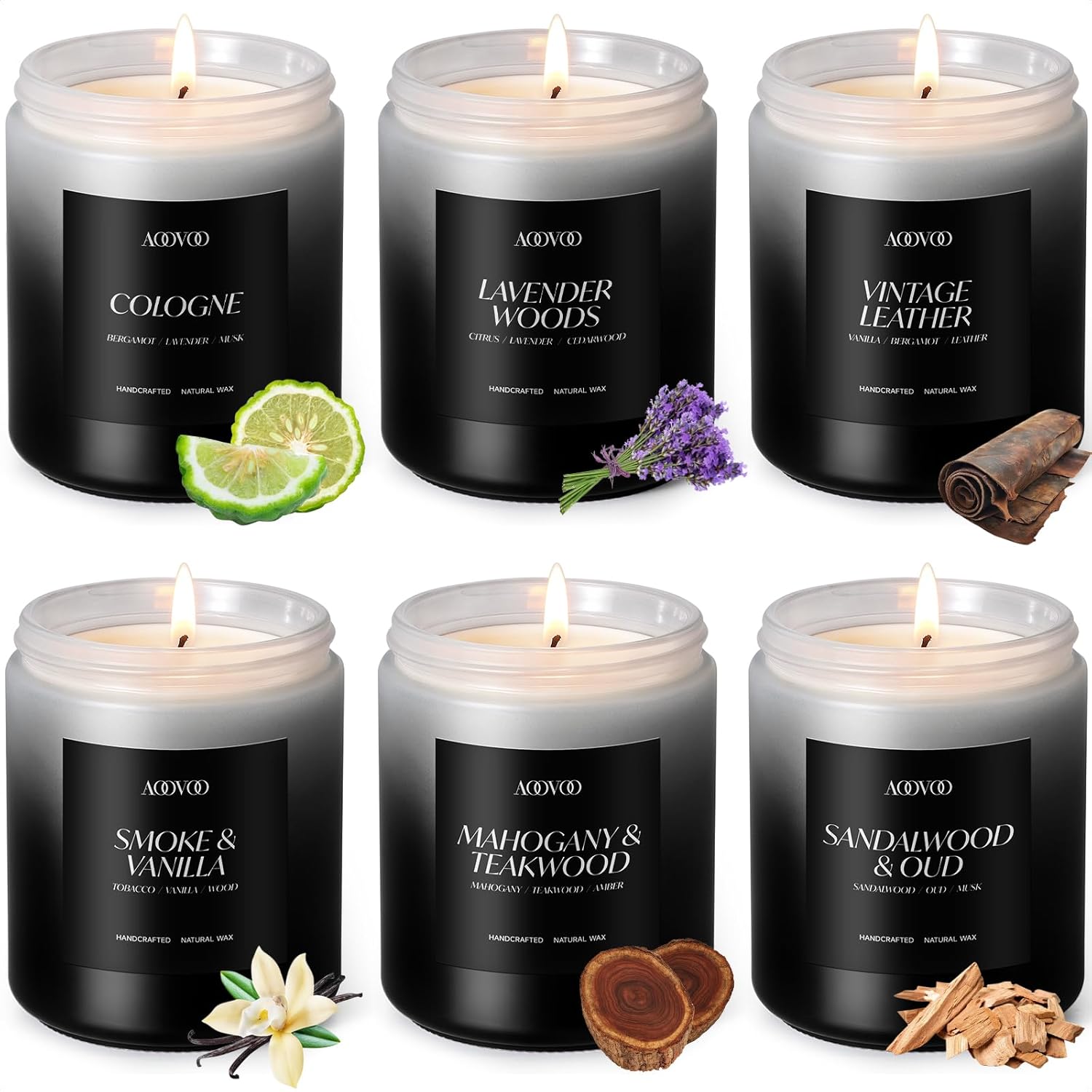
Our pick: AOOVOO Scented Candles Set - 6 Pack Men Candles for Home Scented
 Visit on Amazon →
A six-pack set is the smartest way to buy scented candles if you have not settled on a scent family yet, because six small jars let you run six first burns instead of gambling on one big one. The listing positions this set around a bolder, more masculine home scent profile, so treat that as a starting point and read the actual scent list on the page rather than assuming it. What I would check before buying: the wax blend in the fine print, the jar diameter against the wick, and whether the jars are glass with enough height to keep the flame away from the rim.
The catch with any set is that you will not love all six, and that is fine. You will probably love two, like two, and gift two. That is still a better outcome than a single large jar you resent for 40 hours. Check current Amazon price before you decide, and price it per jar, not per set, because six small candles are not the same purchase as one big one.
Flaws but not dealbreakers: Small jars burn fast, and a set gives you less total burn time than the packaging suggests. If you want one candle for a whole winter, this is not that purchase. Anyone furnishing a bathroom, a home office, or a guest room with scent should start here.
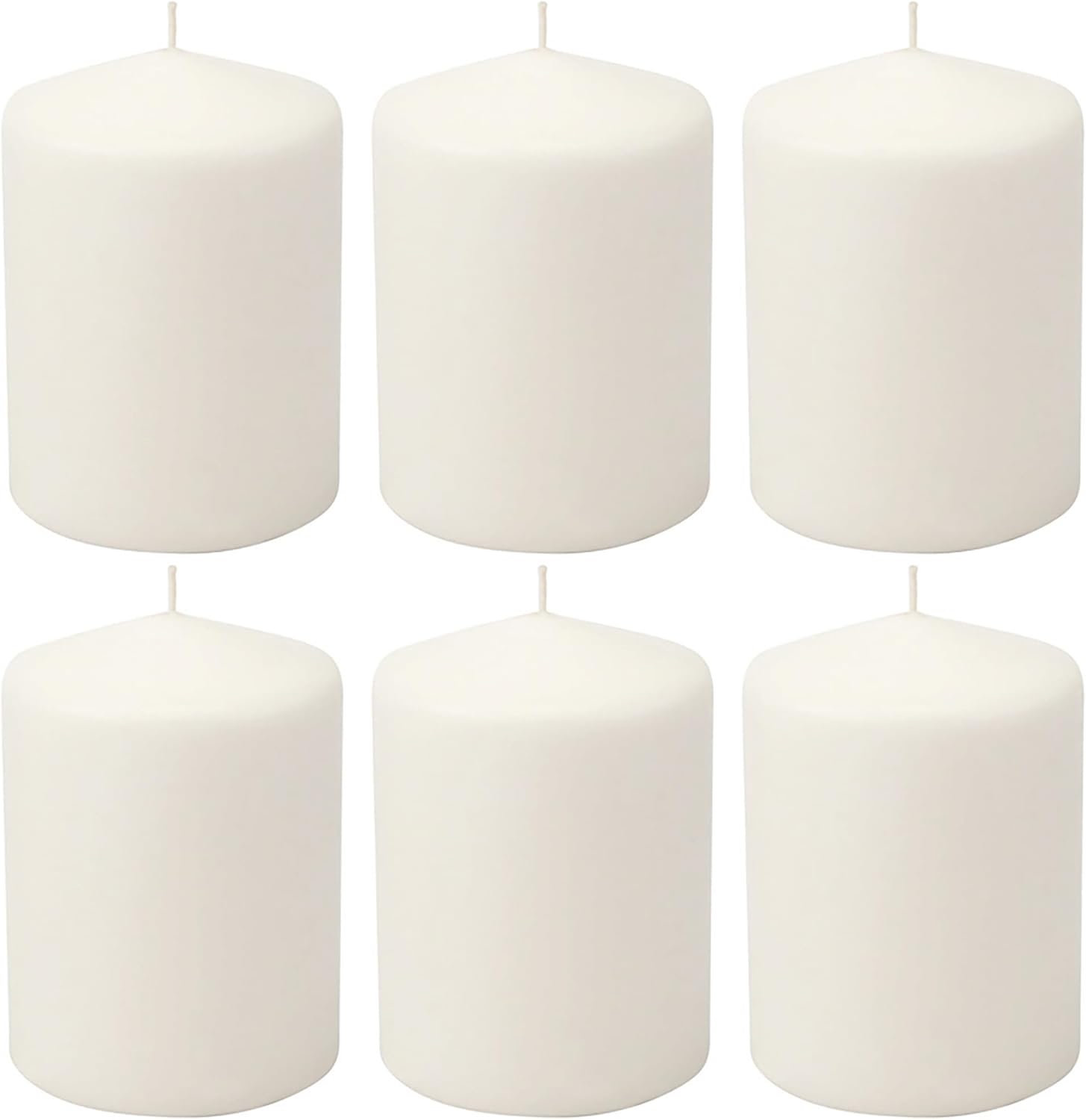
The unscented option: Stonebriar Unscented White Tall Pillar Candles, 35 Hour Burning Candle Pillars, Perfect for Decor, Weddings, Emergencies 3" X 4", 6 count
 Visit on Amazon →
Unscented pillars are the category people forget exists until they need it. The name on this one states a 35 hour burn per pillar, six pillars to the box, three inches across and four inches tall, and that combination is what makes it useful: tall enough to stand in a holder and read as decor, wide enough that the wick has something to work with, and unscented so it can sit on a dinner table without arguing with the food. Weddings, power outages, restaurant tables, a windowsill in December. That is the job.
The pillar is its own vessel, which changes the first-burn rule slightly. You still trim the wick to a quarter inch and you still let the melt pool reach the rim before you quit, but with a pillar that means a ring of melted wax that eventually becomes the wall. Quit early and you get a candle burning down the middle of a standing wax tube, and the walls never catch up. Burn it on a plate or in a holder with a rim, keep it out of drafts, and give it the full two to three hours on the first burn.
Flaws but not dealbreakers: Unscented means unscented, so do not buy this expecting a room to smell like anything. Also, a pillar this size sits too far from the bulb of most candle warmer lamps to melt properly, so the flameless route is not an option here. Check current Amazon price, then divide by the burn hours stated on the listing to see what an hour of light actually costs you. Anyone building an emergency kit or decorating a long table should keep a box of these on hand.
The actual workflow, step by step
Step one: decide what you are buying. Fragrance or light. If you want the room to smell finished, you are shopping for a scented candle and the pillar is the wrong tool. If you want glow, table decor, or a candle that still works when the power is out, unscented is the right answer and throw is irrelevant. Most disappointing candle purchases are a mismatch on this single question.
Step two: read the fine print. Wax blend, fragrance load, wick type, dimensions. More fragrance oil is not better. An overloaded candle soots and smells like a cleaning product at hot throw, and a label that says "non-toxic" on top of mystery fragrance oil is telling you nothing.
Step three: match the wick to the width. A three inch pillar needs a substantially larger wick than a small jar, and a jar candle with an undersized wick will tunnel no matter how patient you are. This is the single most common defect I find, and it is decided at the factory, not by you.
Step four: the first burn. Trim the wick to a quarter inch. Light it. Leave it alone for two to three hours, or until the melt pool reaches the edge. The first burn decides the whole candle. Most "bad candles" are bad first burns, and the person holding the lighter is the one who caused it.
Step five: take the two readings. Hot throw at hour one and hot throw at the halfway mark. Plenty of candles open strong and fade by the middle, which is why a single first impression is worthless. If a listing claims a candle "fills the room" without a distance or a number attached, close the tab.
Step six: trim every other burn. An untrimmed wick mushrooms into a carbon ball, which kills flame height, dims the throw, and streaks soot down the glass. If you have ever returned a candle as defective, there is a decent chance it was just a mushroomed wick and a pair of scissors would have fixed it.
Step seven: do the division. Total burn hours divided by the price you actually paid. A cheap candle that soots up the jar by hour six is not cheap, and an expensive candle that burns clean for eighty hours is not expensive. That number is the only comparison that survives contact with reality.
Step eight: know when to switch to a warmer. A warmer lamp melts the top inch of a jar with no flame, which means no soot, no mushrooming, and roughly triple the life out of the same candle. The trade-off is a gentler hot throw and no ritual. It is the honest answer for bedrooms and for anyone with pets, kids, or a smoke detector that hates them. It is not an option for thick pillars or tall tins, which sit too far from the bulb.
Caveats I would rather you hear now
A set cannot be judged from one candle. If you burn one jar from a six-pack and write off the rest, you have reviewed one sixth of the product, and the other five may behave differently. Give each jar its own first burn.
Storage matters more than people think. Candles parked in a hot garage for a summer sweat fragrance oil and lose throw. Keep them out of direct sun and out of the car.
Drafts are the quiet killer of pillars. A flickering flame burns uneven and tunnels, and no amount of wick trimming fixes a candle sitting next to an open window or a ceiling fan on high.
And be honest about the burn clock. I preach a four hour maximum, and I once burned a candle nine straight hours during a show binge and logged the soot as penance. The rule exists because the wax and the wick both need to stay in agreement, and hour nine is where that agreement breaks.
What I left off this list and why
I am not covering candle warmer lamps, beeswax pillars, or large paraffin jars here, because each of those is its own decision with its own tests. A warmer is a fragrance-without-fire purchase, not a candle purchase. Beeswax is a burn-quality conversation. A big paraffin jar is a throw conversation. Mixing them into one article is how you end up with a list that recommends everything and decides nothing.
The two products above cover the actual fork in the road: scent or light. Everything else is a variation on one of those two.
What this all costs
Both of these listings move around, so check current Amazon price on each page rather than trusting a number from last month, and then run the same math on both: burn hours divided by price.
The scented set is a per-jar purchase, so divide by six before you decide it is a bargain, and remember that small jars burn faster than the box implies. The unscented pillars carry a stated 35 hours per pillar, which gives you a real denominator to work with, and unscented wax has no fragrance load to fight, so the burn tends to be cleaner and more predictable from the first pillar to the sixth.
The number that matters is not the sticker. It is cost per burn hour, and the only way to know it is to read the fine print, light the first wick properly, and keep your own journal. Mine is a stack of notebooks now. A note on your phone will do.