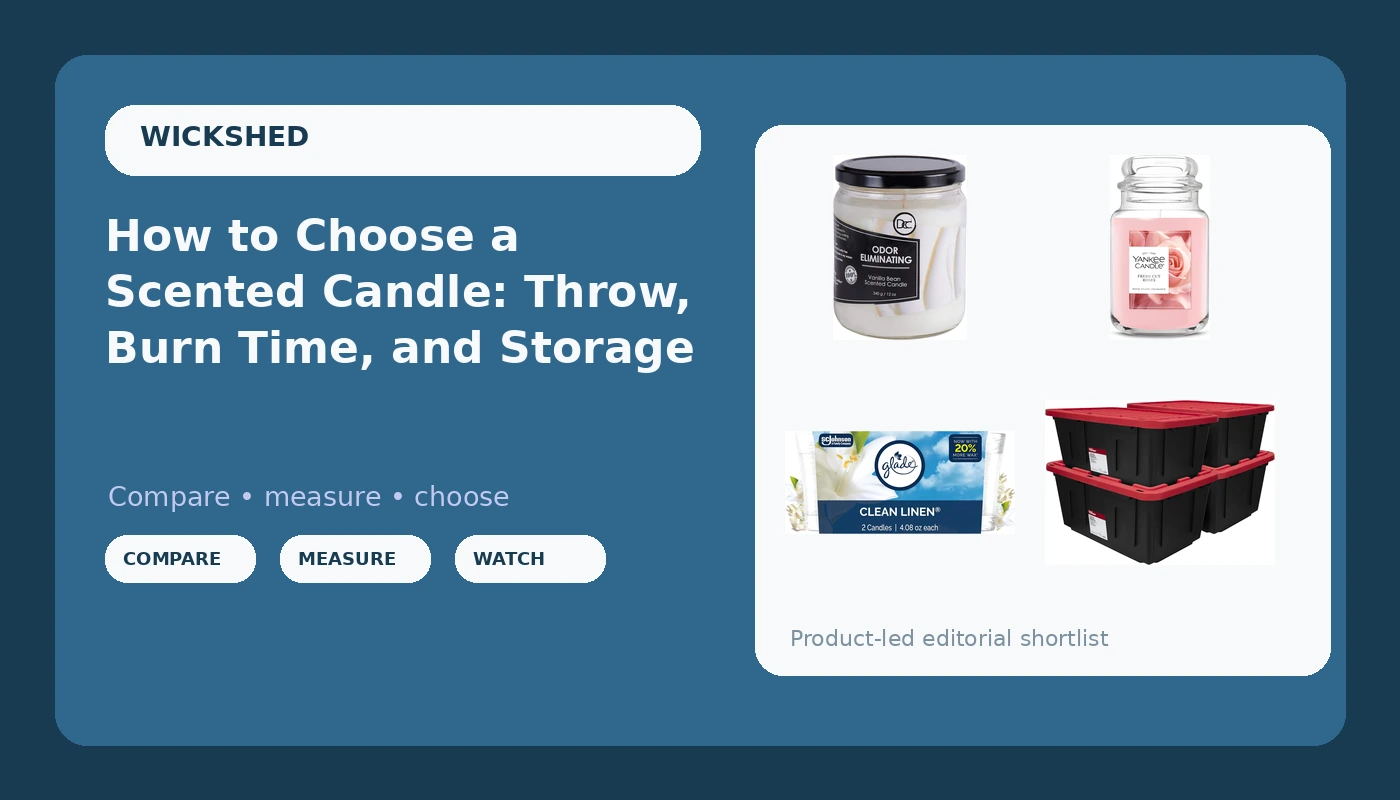
Choosing a scented candle looks like a five-second decision and behaves like a thirty-dollar one. You stand in an aisle, or you scroll a listing page, you smell the cold wax or read the note description, and you commit. Then the candle tunnels straight down the middle, or throws so hard it gives you a headache, or quits at hour nine when the label implied eighty. Most of that disappointment was decided before you lit anything, by the wax blend, the wick, the jar diameter, and the fragrance load. This is an explainer, not a ranking: four listings, four different jobs, and the reasoning that separates a jar worth shelf space from one that only smells good in the store.
Related: The First Burn Rule: Why the Melt Pool Decides Everything →
Quick answer
Match the format to the job before you look at the scent name. A large jar is for a room you sit in for hours, where you want the wax to carry a note across the space. A small jar is for a bathroom, a hallway, or a scent you want to test without committing to twenty-two ounces. A candle sold on odor elimination is doing different work than a candle sold on a single floral note, and a storage bin is not a candle at all; it is what keeps your off-season jars from softening in a hot garage. Decide what the room needs first, then pick the format that delivers it.
Four useful options
| Model | Best fit | What stands out |
|---|---|---|
| Yankee Candle Fresh Cut Roses Scented Candle, 22oz Large Jar | A living room or open plan space you sit in for hours | Large single jar in a classic floral note, the format built for long sessions |
| Vanilla Bean Odor Eliminating Highly Fragranced Candle, 12 Ounce | Kitchens, entryways, and homes with pets | Positioned on odor elimination, with the listing stating up to 80 hours of burn time |
| Glade 1-Wick Scented Candle Jar, Clean Linen, 4.08 Oz, 2 Count | Bathrooms, hallways, and testing a scent family cheaply | Two small single-wick jars, so you can try the scent in two rooms |
| 27 Gallon Heavy-Duty Plastic Storage Bin, Black and Red, Pack of 4 | Storing the overflow of jars you are not burning this season | Four large bins with lids, sized for a collection rather than a single candle |
The long-session jar: Yankee Candle Fresh Cut Roses Scented Candle, 22oz Large Jar
The trade-off with a jar this size is patience. A 22-ounce candle needs a first burn long enough for the melt pool to reach the glass on all sides; quit after forty minutes and you have taught the candle to tunnel, and no amount of later trimming will fully undo it. Floral notes are also the ones most likely to read as soapy when the fragrance load runs high, so a rose candle is worth smelling cold with your nose an inch from the wax before you commit to the whole jar. Set aside two to three hours for the first lighting, keep it out of a draft, and this is the format that rewards you for months.
The odor-job candle: Vanilla Bean Odor Eliminating Highly Fragranced Candle, 12 Ounce
Treat the elimination number and the burn-time figure as the manufacturer's claims, not as results anyone measured for this page. What matters practically is the category: odor-focused candles tend to run a heavier fragrance load than a decorative candle, because they are trying to compete with whatever is already in the air. Vanilla is a good carrier note for that job, since it is heavy and lingers, but heavy also means sweet, and a kitchen that already smells like dinner does not always want to smell like dessert on top of it. If the goal is genuinely gone-smell rather than covered-smell, ventilate first and let the candle handle the residue.
The small-jar test: Glade 1-Wick Scented Candle Jar, Clean Linen, 4.08 Oz, 2 Count
A small jar burns differently from a large one, and it is worth understanding why before you judge it. Less wax around a single wick means the melt pool forms fast and the candle runs hot relative to its volume, so the hot throw arrives quickly and the jar finishes quickly. That makes this format excellent for a bathroom, a hallway, or a guest room, and a poor choice for a big open living space where you want scent to travel. Two jars in the pack also let you split the test across two rooms, which is more useful than burning both in the same spot. The essential-oil line on the label is a fragrance-sourcing detail, not a purity guarantee; the wax blend and wick still decide how it burns.
The overflow bin: 27 Gallon Heavy-Duty Plastic Storage Bin, Black and Red, Pack of 4
Candles are a fragrance product before they are a decor product, and fragrance oils degrade with heat and light. A jar that sits through a summer in a sunbaked garage will still burn, but the cold throw fades and the hot throw gets thinner and flatter, which is why a stored candle sometimes smells like nothing when you finally light it in November. Keep the bins somewhere temperature-stable, stack jars upright rather than on their sides, and put a scrap of paper in the top bin listing what is inside, because four identical bins get anonymous fast.
Prices and availability may change. Product images, names, and retailer links are matched to verified listings. No current price, rating, stock status, or measured result is stated here without current evidence.
What the label actually tells you
Read a candle listing the way a pour room reads a wick chart: from the least glamorous line to the most. The wax blend comes first, because soy, paraffin, and beeswax burn at different rates and carry fragrance differently. A paraffin-heavy blend usually throws harder and further; a soy blend tends to burn cooler and slower; beeswax smells faintly of honey with no added fragrance at all. None of those is automatically cleaner or dirtier than the others. The wick and the additives matter more than the wax's reputation, and "premium" on a label is a sticker, not an ingredient.
Next is the wick, which is the whole game. A single wick in a wide jar will struggle to build a full melt pool, and two wicks in a narrow jar will run hot and burn the wax fast. You rarely get wick specifications on a retail listing, so use jar diameter and wick count as your proxy, then watch the first burn as the real test. After that comes fragrance load, the percentage of oil in the wax. More is not better. Overloaded candles soot, smell sharp, and can read like a cleaning product at hot throw rather than the note on the label.
Finally, burn-time claims. Those numbers are manufacturer estimates from controlled test burns, not promises about your living room, your wick trimming, and your drafty window. The only comparison that holds up across formats is price per burn hour: a large jar that runs clean for a long stretch usually beats a cheap candle that soots up the glass in a single evening. A four-ounce jar and a twenty-two-ounce jar are not competing products, they are two different tools.
How to judge a candle before you light it
- Read the wax and wick line first, then the scent name. If the listing will not tell you what the wax is, assume the cheapest blend that fits the price.
- Smell the cold wax if you can. Cold throw is the cheapest way to screen a candle and the least honest way to judge it, because hot throw is a different performance entirely.
- Check jar diameter against wick count. One wick in a wide jar means a long, patient first burn; multiple wicks in a narrow jar means a fast, hot one.
- Plan the first burn before you strike a match. Two to three hours, no draft, and no quitting early, because the first burn sets the melt pool pattern for the candle's whole life.
- Log hours, flame height, and soot for the first few sessions. A candle that mushrooms by hour three wants a shorter wick; one that streaks the glass wants a trim and a shorter session.
Practical guidance for the first week
- Trim the wick to about a quarter inch before every burn. An untrimmed wick mushrooms, drops flame height, and streaks soot down the jar.
- Cap sessions at around four hours. Longer burns heat the wax and the glass, and the fragrance oil starts to cook off rather than travel.
- Keep candles out of drafts and away from vents. A dancing flame burns unevenly and tunnels one side of the jar.
- Put the lid back on between burns. It protects cold throw and keeps dust out of the wax.
- Store the off-season overflow in a cool, dark, closed bin rather than a sunny shelf, and keep a note in the bin about what is inside.
- Buy the small format to test a scent family, then buy the large jar once you know it works in your room.
Which option should you choose?
Choose the Yankee Candle Fresh Cut Roses Scented Candle, 22oz Large Jar when you want one jar for a room you sit in all evening and you are willing to give the first burn its full two to three hours. Choose the Vanilla Bean Odor Eliminating Highly Fragranced Candle, 12 Ounce when the room has an actual smell problem, from pets to cooking, and you want a heavier fragrance load working on it. Choose the Glade 1-Wick Scented Candle Jar, Clean Linen, 4.08 Oz, 2 Count when you want a bathroom or hallway scent, or when you want to test a fresh-laundry profile in two rooms for very little money. Choose the 27 Gallon Heavy-Duty Plastic Storage Bin, Black and Red, Pack of 4 when the collection has outgrown the shelf and the jars you are not burning this season need a cool, dark, lidded home.
One caveat on all four: the burn-time and odor-elimination figures on these listings come from the manufacturers, and candle performance depends on how you trim, how long you burn, and where the jar sits. Nothing here substitutes for reading the fine print on the listing you actually buy.
The bottom line
A candle is a wax, a wick, and a fragrance that have to agree with each other, and the label is the last thing worth reading. Pick the format for the job: a large jar for long sessions, a small jar for small rooms and cheap scent tests, an odor-focused candle where there is something to eliminate, and a lidded bin so the rest of the collection survives until next season. Then trim the wick to a quarter inch, let the first melt pool reach the glass, and judge the candle on how it performs at hour three, not how it smelled in the store.