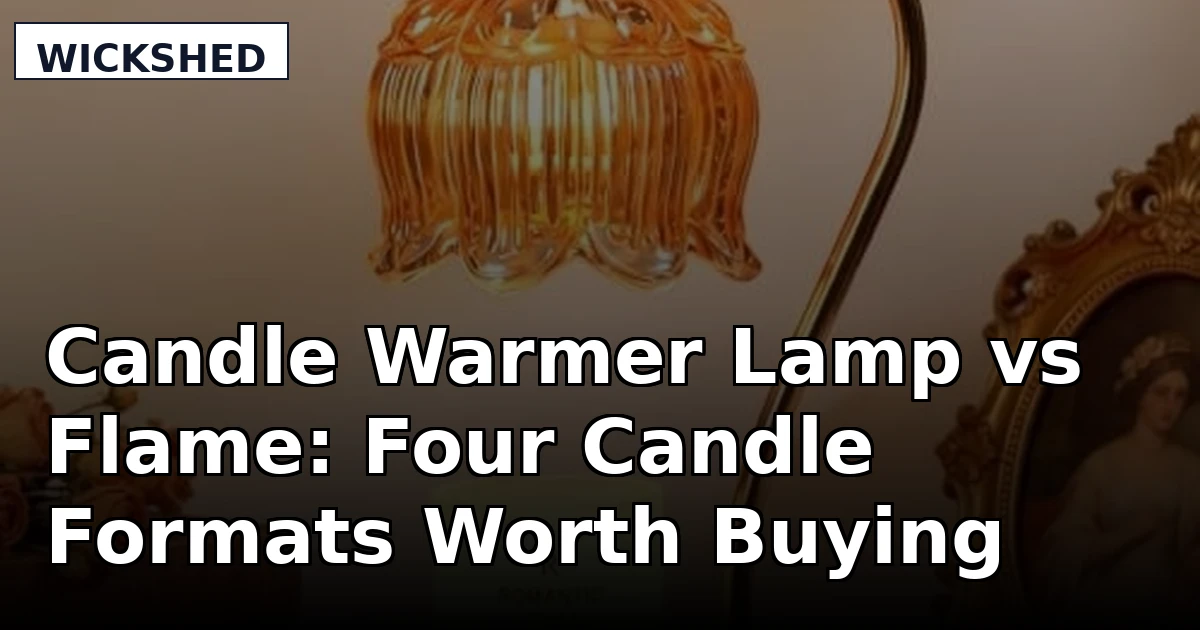
Most candle shopping goes wrong before anyone strikes a match, because the shopper picks a scent and never thinks about the format. The candle warmer lamp versus candle flame question is the first fork in the road: one melts wax with a bulb and never produces a live flame, the other burns a wick and gives you the flicker, the ritual, and a hotter, faster scent. After that you are choosing between a four-jar seasonal soy set, a single 3-wick jar, and a box of beeswax tapers. Those are three different products for three different rooms, and buying the wrong one is exactly why a candle that smelled wonderful in the store ends up in a drawer.
Related: The First Burn Rule: Why Melt Pools and Tunneling Decide Everything →
Quick answer
Match the format to the room, not to the label. If you want fragrance without an open flame, in a bedroom, a rental, or a house with pets and sensitive smoke detectors, a candle warmer lamp is the practical pick. If you want a season's worth of variety from one purchase, a multi-jar soy set gives you four scents and four separate jars to rotate. If you want a wide melt pool and scent that spreads through a room quickly, a 3-wick jar does that because three flames heat more wax at once. And if you want light for a table, a mantel, or a dinner, beeswax tapers are the honest answer: they are for atmosphere and ritual, not for throw.
Four useful options
| Model | Best fit | What stands out |
|---|---|---|
| Funistree Flower Candle Warmer Lamp with Timer, Dimmable, Lotus Wax Warmer - Lily Amber | Scent without an open flame | Dimmable lamp warmer with a timer, sized for jar candles |
| AOOVOO Fall Candles Set, 4 Pack, 28 oz Natural Soy Wax | A season of rotation in one purchase | Four jars and four autumn scents, listed as a 200-hour set |
| Raspberry Strawberry Vanilla Candle, 3-Wick Scented Soy Candle, 15.8 oz | One jar, one room, fast coverage | Three wicks in a single 15.8 oz soy jar |
| 16PCS 9" Natural Beeswax Taper Candles | Table light and ritual | Sixteen 9-inch beeswax tapers, described as dripless and smokeless |
The flame-free option: Funistree Flower Candle Warmer Lamp with Timer
A warmer lamp works on a completely different principle from a flame. The bulb sits above the jar and melts the top inch of wax, which releases fragrance oil into the air without combustion. No combustion means no soot streak down the glass, no carbon ball on the wick, and a wick that stays exactly where it was when you first opened the jar. The wax pool simply re-solidifies when you switch the lamp off, and the next session starts over from the same place.
The trade-off is real and worth naming. A bulb runs cooler than a flame, so the hot throw is gentler and takes longer to build. You also lose the flicker, and if the flicker is the reason you own candles, no warmer will fix that. The dimmer and timer are what make this style usable day to day: a lower setting for a desk or a bedside table, a higher setting when you want the scent to move. Before you trust a warmer with an expensive jar, check the height adjustment and make sure the shade is not sitting close enough to scorch a label.
The seasonal set: AOOVOO Fall Candles Set, 4 Pack
Four jars solve a problem a single jar cannot: you get variety without committing to one scent for a whole season, and you can move a jar from the living room to the kitchen without carrying the whole purchase with you. The practical benefit is that each jar gets a proper first burn. One jar, burned patiently, develops an even melt pool. Four jars, burned one at a time, all get the same treatment.
There is a discipline to a set like this. Rotating four jars means each one sits unused for stretches, and soy wax is perfectly happy to wait as long as you keep the jars out of direct sun and away from heat. What soy does not forgive is a rushed first burn. If you light a jar and blow it out after forty minutes, you have started a tunnel, and no amount of later patience fixes it. Pick one jar, let the pool reach the glass, then cap the session at around four hours. The autumn scents here, pumpkin, apple cinnamon, clove, and wheat vanilla, are the kind that read stronger warm than cold, so judge them at hour one rather than with your nose an inch from the wax.
The everyday 3-wick: Raspberry Strawberry Vanilla Candle, 15.8 oz
Three wicks change the math of a burn. With three flames spread across the surface, the wax heats from more than one point, the melt pool reaches the glass faster, and the scent moves into the room sooner than it would from a single centered flame. That is why 3-wick jars feel generous in a living room or an open kitchen. The same physics explains the downside: more flame means more wax consumed per hour, so a 3-wick jar usually finishes well before a single-wick jar of the same weight.
Three wicks also mean three trims. Every one of them mushrooms, and if you trim only the one you can see from where you are standing, the other two will soot the glass and shorten the wick you just fixed. Trim all three to roughly a quarter inch before each burn, keep the jar away from a draft so the flames do not dance and smoke, and cap the session at four hours. Fruit-forward scents like raspberry, strawberry, and vanilla tend to read bright and sweet at hot throw, which is a different experience from the same wax smelled cold in the jar.
The taper set: 16PCS 9" Natural Beeswax Taper Candles
Tapers are not a throw product and should not be judged as one. Beeswax carries its own faint honey note from the wax itself, with no added fragrance oil, and the point of a taper is light: a dinner table, a mantel, a window ledge, a bath. Sixteen of them in one box means you can burn a pair without rationing, which matters because tapers are the candle people are most likely to own two of and never replace.
Beeswax is dense and burns slowly, and it is the cleanest wax I have watched in a pouring room. Two practical notes. First, always use a holder that fits the base snugly, because a loose taper leans and drips regardless of what the box says. Second, keep tapers out of air currents. A taper in a draft burns unevenly, tunnels down one side, and looks like a melted crayon by dessert. Unscented tapers are also the right choice when the room already smells like food and you do not want a vanilla jar fighting with the roast.
Prices and availability may change. Product images, names, and retailer links must be matched by verified ASIN. Do not state a current price, rating, stock status, or measured result without current evidence.
How a candle warmer lamp differs from a flame
The two formats fail in opposite directions, which is the whole reason to own both.
A flame burns fuel. The wick pulls melted wax up into the flame, the wax vaporizes, and the fragrance oil goes with it. That process runs hot, which is why a burning candle throws scent across a room quickly, and it also produces the byproducts you clean off the glass: soot from an untrimmed wick, carbon from a mushroomed tip, and a black smear when the flame gets long enough to lick the side of the jar. A flame also consumes wax, so the jar level drops every session.
A warmer lamp does not burn anything. The bulb raises the wax temperature until the top layer melts and releases fragrance oil, and then it stops there. Nothing is consumed, no soot forms, and the wick is never lit, so the jar can be melted and re-solidified for as long as the fragrance oil holds out. The cost is intensity. A bulb cannot reach the temperature of a flame, so the scent is quieter and slower to arrive, and a large open room will eat it. In a closed bedroom, that gentler output is often exactly right. In a great room, a flame still wins.
One more difference that matters for gifts: a warmer lamp is reusable. The jar eventually gives up its scent, but the lamp stays, and a new jar is the only replacement you need. A taper set and a jar candle are consumables. That changes what you are actually buying.
What the wick and wax actually tell you
Ignore the front label and read the fine print, because the wick is doing more work than the wax name.
Soy, paraffin, and beeswax behave differently and none of them is automatically superior. Soy burns cooler and slower, which is why soy jars often tunnel if the wick is undersized for the jar's diameter. Paraffin runs hot and carries fragrance further, which is why some of the loudest candles on a shelf are paraffin blends. Beeswax is dense, burns slowly, and needs no added fragrance to smell like something. The label rarely tells you the fragrance load, but if a jar smells like a cleaning product at hot throw, the load is probably high and the oil is probably cheap.
Wick count is a sizing decision, not a marketing one. A wide jar with one small wick will tunnel no matter how patient you are, because a single flame cannot heat the whole surface. That is the honest case for three wicks in a wide jar, and the honest case against putting a taper in a warmer. Match the wick to the diameter and the wax, then let the first burn do its job.
- Decide flame or no flame first. A warmer lamp and a lit wick are not interchangeable, and the room decides.
- Count the rooms and the weeks. One jar for one room, four jars for a season of rotation, tapers for a table.
- Check the wick against the jar. Three wicks in a wide jar, one wick in a narrow one, tapers in holders only.
- Plan the first burn before you light anything. Trim to a quarter inch, let the pool reach the edge, cap it at four hours.
- Compare cost against the burn hours the maker lists, not against the sticker alone. A jar that burns twice as long is not twice the price by accident.
Practical guidance
- Trim every wick to about a quarter inch before every burn, and remember that a 3-wick jar means three trims.
- Give the first burn enough time for the melt pool to reach the glass, and never quit after an hour.
- Keep sessions to roughly four hours. Longer burns raise the jar temperature and shorten the candle's life.
- Use holders for tapers, keep them out of drafts, and never leave any lit candle unattended.
- Check a warmer lamp's height and dimmer setting before you use it on a jar you love, and keep the bulb clear of the label.
Which option should you choose?
Choose the Funistree Flower Candle Warmer Lamp with Timer when you want fragrance in a bedroom, a rental, or a home with pets and children, and you would rather not manage an open flame. Choose the AOOVOO Fall Candles Set when you want a season of variety from one purchase and you are willing to rotate four jars properly instead of burning all of them at once. Choose the Raspberry Strawberry Vanilla Candle when one room needs scent quickly and you want a single wide jar with three wicks. Choose the 16PCS Natural Beeswax Taper Candles when the point is light on a table, not throw in the air.
One caveat worth stating plainly. Burn-hour figures in a listing are the maker's numbers, not a measurement of your room. Drafts, wick trimming, ceiling height, and how long you actually leave a candle lit will move the result more than the label will. The same is true of any warmer: the scent you get depends on the jar, the bulb setting, and how close you are sitting. Treat the listed specs as a starting point and let your own first burn tell you the rest.
The bottom line
The candle warmer lamp versus candle flame decision is really a decision about the room, not the candle. A dimmable warmer lamp is the sensible answer wherever an open flame is inconvenient or unwanted, and it stretches a single jar considerably further. A four-jar seasonal soy set is the best value in variety, provided you give each jar a proper first burn. A 3-wick jar is the tool for getting scent moving in a wide space, and beeswax tapers are for the table, where light matters more than throw. Buy the format that fits the room, trim the wicks, and let the first burn reach the edge. That single habit will do more for your candles than any label ever will.